guides
Hotel Toiletry Formulas: What to Put in the Spec
UMYAN · Sep 15, 2026
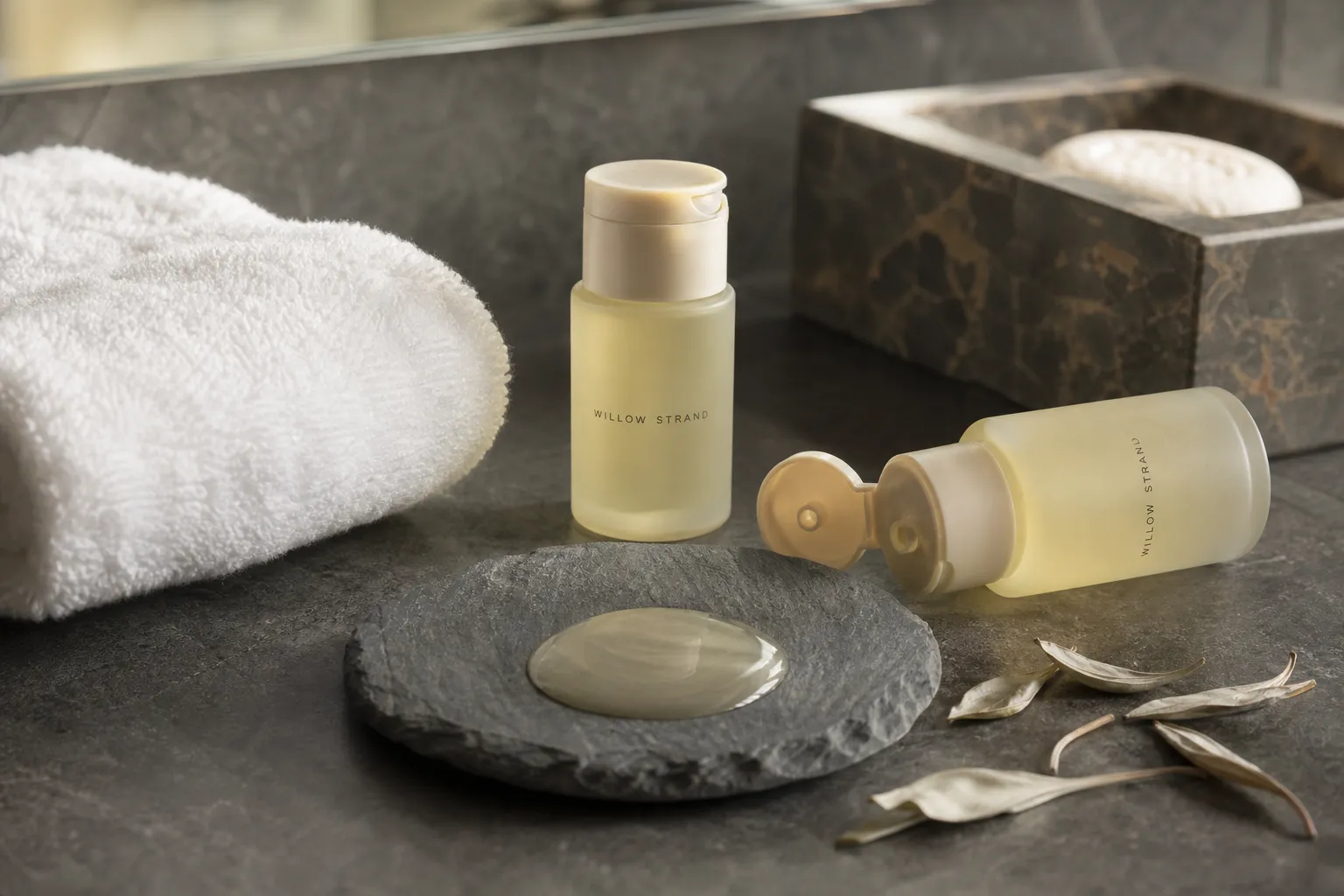
A hotel toiletry formula spec should state five things: the base type (classic, sulfate-free, amino-acid or vegan), the free-from claims you need, the fragrance (matched, bespoke or fragrance-free), the colour, and the documents that back it all up. Most tenders we see specify the bottle size, the label and a scent name — and say nothing about what goes inside.
That gap shows up later, usually in a review. Reading bulk-toiletry buyer reviews this month, one complaint kept coming back in different words: the packaging looked expensive, and the product didn’t. We’ve made hotel bath care since 2013, and it’s the complaint we’d most like buyers to prevent, because it’s decided at the spec stage, not on the production line.
Why packaging gets specified and formula doesn’t
Packaging is easy to specify because you can see it. Size, shape, cap and print all fit on a drawing, and a sample either matches or it doesn’t.
A formula is harder to see, so it gets reduced to a scent name. The result is a premium bottle wrapped around whichever base hits the target price. Guests don’t look at the bottle for long. They notice the lather, the smell once it’s rinsed off, and how their hair feels the next morning.
So write the formula down with the same care as the artwork.
The five formula lines worth writing down
| Spec line | What to write | Why it matters |
|---|---|---|
| Base type | Classic, sulfate-free, amino-acid or vegan | Decides how the product cleans and feels, and moves the cost |
| Free-from claims | Only the exclusions you’ll communicate or your market requires | Every claim has to hold up against the ingredient list |
| Fragrance | Matched, bespoke or fragrance-free | The part guests remember, and the easiest to drift on a reorder |
| Colour | Clear, pearlised or a named tint | A tint that nobody sampled can end up on the bathroom surfaces |
| Documents | INCI list, manufacturing standard, fragrance declarations | Turns every line above into something you can check |
Classic, sulfate-free or amino-acid: which base?
Classic guest formulas use sulfate surfactants — SLS and SLES are the familiar ones. They lather generously, rinse clean and usually cost less. For most rooms there’s nothing wrong with them.
Sulfate-free swaps those for milder surfactants. It’s a sensible spec when your brand talks about gentle, considered products, or your guests skew toward coloured and treated hair. Expect a softer lather: guests used to classic shampoo sometimes read that as “it isn’t working,” which is worth knowing before you switch a whole property.
Amino-acid bases are gentler again. We build our CHUEN RAIN kids line on them for a practical reason — stinging eyes end a family bath fast. They’re a strong choice for family rooms and kids’ sets.
Vegan is a sourcing claim rather than a cleaning style, and it can sit on top of a classic or sulfate-free base.
We produce all four from a library of 1,000+ in-house formulas, so the question we ask back is rarely “can you make it?” It’s “who is it for?”
Buying tip: don’t change the base type and the fragrance in the same order. If guests react, you won’t know which change they’re reacting to.
Free-from claims: write fewer, prove all of them
Free-from lists grow because each exclusion sounds harmless to add. But every exclusion you print is a claim, and every claim should be checkable against the INCI list — the standardised ingredient declaration.
Two things we tell buyers:
- Only specify what you’ll communicate or what your market requires. An exclusion nobody sees still narrows the formula choice, and can raise the cost, without a single guest knowing.
- Paraben-free isn’t preservative-free. A water-based shampoo needs a preservative system. Removing parabens means using a different one, not none.
For example, our kraft spout pouches carry a specific, checkable claim: 0% parabens, SLS, EDTA, DEA and artificial colours, with palm-based ingredients from RSPO-certified suppliers. Notice where that last certificate sits — with the raw-material supplier, not with us. If a toiletry factory tells you it is “RSPO certified,” ask whose certificate it actually is.
Fragrance: essential oils aren’t the quality test
One review we read complained that the ingredient list showed no essential oils, as if that proved the product was cheap. It doesn’t prove much.
Hotel amenity fragrance is normally a compounded fragrance oil — a blend that can include essential oils. A compounded oil is what lets a scent stay identical from one batch to the next, which is exactly what a hotel needs when a returning guest expects the shower to smell the way it did last year. We cover the difference in more depth in why hotels smell good.
What belongs in the spec instead:
- Matched or bespoke. Match a scent you already use, or develop your own. We develop fragrance with Givaudan.
- Held on file. Ask the supplier to confirm the formula is kept on record, so a reorder is a repeat rather than a reinterpretation.
- A fragrance-free option. Useful for guests with sensitive skin or fragrance allergies who ask for one.
- Declarations. Ask for the IFRA certificate and allergen declaration for each accord.
Buying tip: keep a sealed sample from your first approved batch. When a reorder “smells different,” you compare it against the real thing instead of a memory.
Colour: the line almost nobody specifies
Colour rarely makes it into a tender, and it should. A strong tint looks good in a clear bottle on a product photo. Buyers of dyed bulk formulas also report it marking tubs and shower curtains — a problem housekeeping discovers, not the purchasing team.
Our guest shampoo comes clear or pearlised. If you want a tint for brand reasons, specify it, sample it, and use it in a real shower before you approve.
The documents that make the spec real
A spec is only as good as what you can check. For bath and body formulas, ask for:
| Document | What it tells you |
|---|---|
| INCI list | Every ingredient, in standard naming — your check for each free-from claim |
| Manufacturing standard | Whether it’s made under cosmetic GMP. Ours is produced under GMPC in a class-100,000 cleanroom |
| Market compliance | For the US, whether the formula is made to FDA-market requirements |
| Fragrance declarations | The IFRA certificate and allergen declaration for each accord |
We provide INCI lists and supporting documentation for our formulas, and our factory-level certificates are listed on the certifications page. If a supplier can’t give you an INCI list before you order, treat that as your answer.
How to test a formula sample
Don’t approve a formula by sniffing the open bottle. Use it the way a guest would:
- Wash with it in a real shower — ideally at the property, with your own water.
- Smell it after rinsing, and again once dry. That’s the scent the guest walks out of the room with.
- Check the texture in the bottle. A thin formula pours fast and runs out early, the same problem we flag in our toiletry sizes guide.
- Use the shampoo and conditioner together. They’re specified separately but experienced as a pair.
- Put the sample next to your current product. Compare, don’t just approve.
Mistakes buyers make with formula specs
- Specifying the scent name and nothing else. Two suppliers can put very different bases behind the same “white tea.”
- Premium packaging on a base chosen for price. The bottle promises one tier and the lather delivers another. Match the formula to the room tier as deliberately as the packaging.
- Adding free-from claims nobody will communicate. They narrow the formula for no visible benefit.
- Changing the formula when you change the format. Moving from guest bottles to refillable dispensers? Keep the same formula and fragrance in the 1L–5L bulk. Change the packaging, not the experience.
How to order
Custom formulas and branding start at 5,000 units per item, with free formula matching, design and sampling before production. Standard production is 25 working days from deposit, once the formula and artwork are approved.
The quickest start is to send what you use today — the product, the scent or its INCI list — plus your room tiers. We’ll match or improve on it through custom formula development and send physical samples. Request a quote when you’re ready.
Frequently asked questions
What should a hotel shampoo formula specification include? The base type (classic, sulfate-free, amino-acid or vegan), any free-from claims, the fragrance (matched, bespoke or fragrance-free), the colour, and the documents that prove it — at minimum an INCI list and the manufacturing standard.
Are sulfate-free toiletries better for hotels? Not automatically. Sulfate-free is milder and suits guests with coloured or treated hair, but it lathers less, which some guests notice. Classic formulas are fine for most rooms. Choose by guest profile and room tier.
Does paraben-free mean a toiletry has no preservatives? No. Water-based toiletries need a preservative system. Paraben-free means a different preservative is used.
Do hotel toiletries contain essential oils? Most use a compounded fragrance oil, which can include essential oils. A compounded oil keeps the scent consistent between batches, which matters more to a hotel than whether essential oils appear on the list.
What documents should a hotel toiletry supplier provide? An INCI list for each formula, evidence of cosmetic GMP manufacturing such as GMPC, compliance for your destination market (for example FDA-market requirements in the US), and IFRA and allergen declarations for the fragrance.
Can you match our current hotel shampoo? Yes. Send the product, the scent or its INCI list. We match from 1,000+ in-house formulas, with fragrance developed alongside Givaudan, and send samples before production.
Rewriting the formula side of your amenity spec? Send your current products and room tiers and we’ll propose matched formulas with samples. Browse the bath & body range or get in touch.