guides
Why Hotels Smell So Good: The Scent Behind the Lobby
UMYAN · Aug 4, 2026
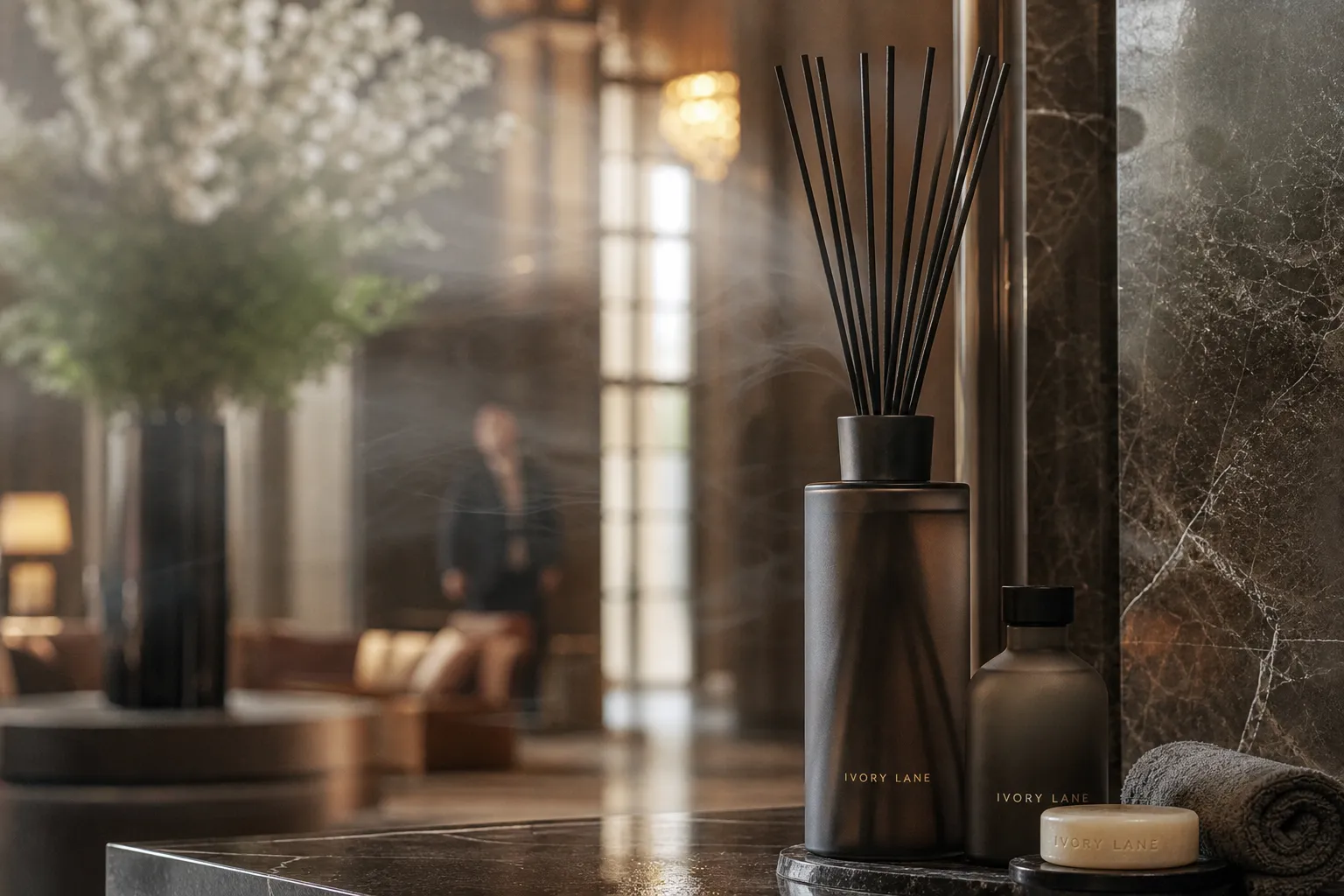
That smell hits you about three steps inside the lobby, and it is not an accident. It is a specified fragrance, delivered through a chosen device, at a concentration someone signed off on — usually with a contract behind it.
We make room fragrance for hotels: reed diffusers, flameless diffusers, refill oils and room sprays, formulated with fragrance houses including Givaudan. So this guide answers the question two ways. First, honestly, for the guest who came here wondering what is that smell? Then for the hotelier who came here wondering how do I get one of my own?
The short answer
Hotels smell good because of four separate systems working at once — and most guests assume it’s only the first one.
| System | What it is | Where you notice it |
|---|---|---|
| Ambient scenting | Fragrance oil vaporised by a diffuser, sometimes into the HVAC | Lobby, corridors, lifts, spa |
| Reed diffusers | Rattan reeds wicking scented oil, no power needed | Guest rooms, bathrooms, reception desks |
| Room & linen spray | Aerosol or pump spray applied by housekeeping | The room at turndown, on pillows |
| Amenity fragrance | The scent inside the shampoo, soap and lotion | The bathroom, on the guest afterwards |
The fourth one is the sleeper. A lobby scent lasts as long as you stand in the lobby. The shower gel scent goes home on the guest — which is why hotel groups increasingly want the amenity fragrance and the ambient fragrance to be the same accord. That’s the whole idea behind a signature scent programme.
What’s actually in the bottle
A hotel fragrance is a fragrance oil — a blend of aroma compounds and essential oils, diluted in a carrier. It is not perfume in the fine-fragrance sense, and it is not an essential oil on its own.
That distinction matters commercially. Pure essential oils are volatile, expensive, seasonally variable in price, and they fade fast in an open space. A compounded fragrance oil is built for throw (how far the scent travels) and longevity (how long it holds), and it can be reproduced identically batch after batch for years. A hotel group with 40 properties needs the scent in Bangkok to match the scent in Lisbon. Only a compounded formula does that.
The typical build:
- Top notes — citrus, green, aquatic. What you smell in the first ten seconds. Gone within the hour.
- Heart notes — florals, tea, light spice. The recognisable character of the scent.
- Base notes — woods, musk, amber, vanilla. Slow, heavy molecules that hold for hours and do the actual lingering.
Lobby scents lean heavily on the base. It’s why so many hotels smell of white tea, fig, sandalwood, bergamot or clean musk — those materials are stable, broadly liked, and they survive being pushed through a diffuser all day.
The honest version: most “signature” hotel scents come from a fairly small set of well-tested accords. Genuinely bespoke fragrance development exists, but it costs more and takes months. Many programmes are a stock accord with a small custom modification and an exclusive name.
How the scent gets into the air
Four delivery methods, and the choice is mostly about space size and whether you have power and staff.
| Method | Coverage | Power? | Best for | Trade-off |
|---|---|---|---|---|
| Cold-air diffusion | 100–1,000 m² | Yes | Lobbies, atriums, spa | Highest cost, needs servicing |
| HVAC-integrated | Whole floors | Yes | Large properties, chains | Installation work, hardest to change |
| Reed diffuser | 15–40 m² | No | Guest rooms, bathrooms, reception | Fades; needs refills or reed replacement |
| Room / linen spray | Per-room, on demand | No | Turndown, post-clean, smoke recovery | Labour-dependent, inconsistent |
Cold-air (nebulising) diffusion is the one behind that even, everywhere-at-once lobby scent. It atomises neat oil into a dry micro-mist without heat or water, so nothing gets diluted and nothing gets cooked. Heat-based and water-based diffusers alter the fragrance profile — a scent designed for cold diffusion smells wrong through a steam humidifier.
Reed diffusers are the workhorse for guest rooms because they cost nothing to run, make no noise, need no socket and can’t be knocked over into an electrical fault. A 150ml diffuser holds scent in a standard room for roughly 8–12 weeks depending on airflow and how often the reeds get flipped.
Room sprays aren’t a scenting system so much as a correction tool — housekeeping uses them to reset a room after a heavy clean or a smoke complaint, and at turndown in premium tiers.
Why it never smells the same at home
This is the most-asked version of the question, so here’s the real answer, and it isn’t a mystery.
- Concentration. Hotels run fragrance loads a consumer product never would. A lobby diffuser is dispersing neat oil continuously into a room with high ceilings and constant air exchange.
- Air movement. Hotel HVAC is running hard, all the time. Scent moves and refreshes instead of settling into a corner.
- Nothing competes. No cooking, no pets, no laundry, no last night’s dinner. The scent lands on a neutral background — that “clean” impression is partly the absence of other smells.
- Layering. You’re smelling the lobby diffuser, the linen spray, the amenity fragrance and freshly laundered cotton simultaneously. Buy one reed diffuser and you’ve bought one quarter of the effect.
- You associate it with being on holiday. Scent memory is genuinely the strongest memory channel there is. Some of what you’re chasing isn’t in the bottle.
If you want to get close at home: a reed diffuser in the entryway, unscented laundry detergent, and a linen spray on the bedding will do more than an expensive candle will.
Building a signature scent programme
If you’re on the hotel side, here’s the sequence that actually works.
1. Decide what the scent has to say. Coastal resort and urban business hotel need different answers. Write the brief in adjectives before anyone smells anything — warm, woody, understated is a usable brief; nice is not.
2. Test in the actual space, not on a blotter. Fragrance behaves completely differently at scale. Marble and glass lobbies read scent as sharper; carpet and textile absorb and soften it. Always run a live trial before committing.
3. Decide how far the scent extends. Lobby only is the cheapest and most common. Lobby + corridors is the usual upgrade. Extending into amenities — shampoo, soap, lotion in the same accord — is what makes a scent genuinely yours, because the guest carries it home. This is where we come in: the amenity range is manufactured in your accord across bottles, bars and diffusers.
4. Lock the supply chain. Fragrance is the one input where a substitution is instantly obvious. Confirm your supplier can hold the formula, document it, and reproduce it at volume. We keep formulas on file with 1,000+ existing formulations and a 20-person R&D team, so a scent specified in year one is still identical in year five.
5. Budget realistically. Ambient diffusion is an operating cost that runs forever — hardware, oil, servicing. Reed diffusers and amenity fragrance are unit costs that scale with occupancy. Most properties start with reed diffusers in rooms plus one lobby unit, then extend once the scent has proven itself.
Buying tip: ask any fragrance supplier for the refill price before the hardware price. Diffuser hardware is often sold cheap precisely because the oil is where the margin lives, and a five-year refill commitment is the real contract you’re signing.
Frequently asked questions
What is the smell in hotel lobbies called?
There’s no single name — the industry calls it ambient scenting or a signature scent, and each hotel group names its own accord. The scent itself is a compounded fragrance oil dispersed by a cold-air diffuser, often built on white tea, fig, bergamot, sandalwood or clean musk.
How do hotels make their rooms smell fresh?
With a combination: a reed diffuser or small diffuser in the room, linen and room spray applied by housekeeping, amenity products in a matching fragrance, and strong ventilation between stays. No single product does it alone.
Can I buy the same scent my hotel uses?
Sometimes. Larger groups sell their signature scent as a retail diffuser or candle. Otherwise the fragrance is exclusive to the property under contract, and the closest you’ll get is a similar accord — white tea and fig are the two most widely used families.
What kind of diffuser do hotels use?
Lobbies and public areas use cold-air nebulising diffusers, which atomise neat oil without heat or water so the fragrance isn’t altered. Guest rooms typically use reed diffusers — no power, no noise, no fire risk. Large chains sometimes integrate scent into the HVAC system.
How long does a hotel reed diffuser last?
A 150ml reed diffuser typically scents a standard guest room for 8–12 weeks. Airflow, room size and how often the reeds are flipped all change that. Most hotels run a refill cycle rather than replacing the whole unit.
Is hotel fragrance safe for guests with allergies?
Reputable hotel fragrances are formulated to IFRA standards, and hotels normally keep a proportion of unscented rooms available on request. If you’re specifying a programme, ask your supplier for the IFRA certificate and allergen declaration for every accord.
Can we match our amenities to our lobby scent?
Yes, and it’s the highest-impact version of a scent programme. The same fragrance accord can be dosed into shampoo, conditioner, shower gel, lotion, soap and reed diffuser refills, so the guest experiences one continuous scent from the lobby to the shower.
Thinking about a signature scent for your property? Request a quote with your room count and the spaces you want scented, and we’ll come back with a diffuser and amenity fragrance plan. You can also browse our room fragrance range or read the procurement-side guide to signature scent programmes.