guides
Refillable vs Single-Use Hotel Toiletries: The Real Cost Per Room Formula
UMYAN · Oct 28, 2026
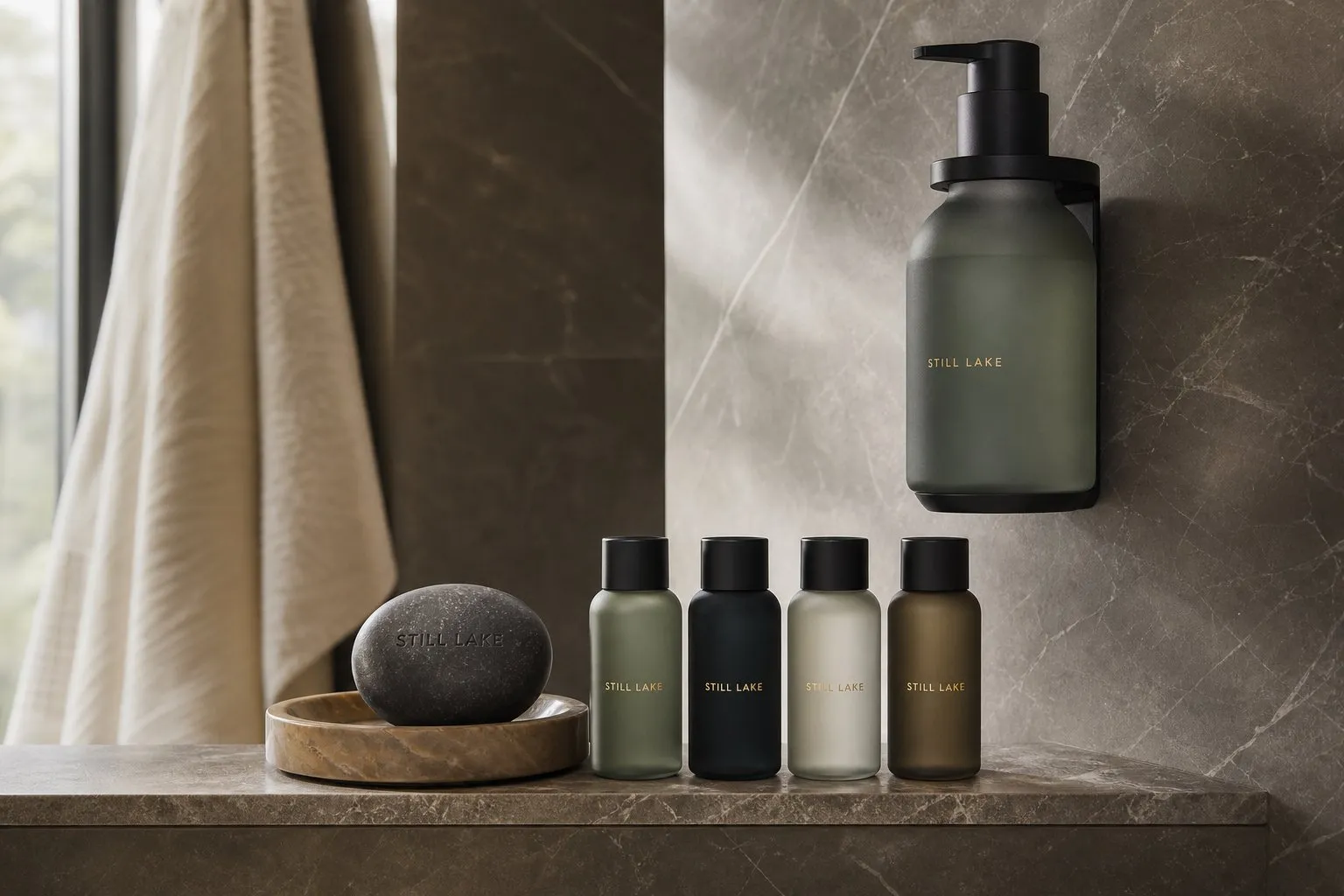
Switching from single-use 30ml toiletry bottles to wall-mounted refillable dispensers is widely promoted as a guaranteed cost-saving and eco-friendly upgrade. But when hoteliers examine their monthly invoices after a rushed transition, the numbers often tell a very different story.
Some properties see their guest-room toiletry expenditure plummet by 22% within five months. Others discover that liquid theft, tampering, broken brackets, and housekeeping refill bottlenecks have quietly eliminated their projected savings.
As a hotel amenities manufacturer running our own 10,000 m² clean-room facility in Yangzhou since 2013, we produce both formats — hundreds of thousands of custom-branded 30ml bottles and 5L commercial bulk liquids alongside our WallSuite™ locking dispenser systems every month. We have no commercial incentive to push one over the other.
Here is the plain, unvarnished financial arithmetic behind both systems, the exact Cost Per Occupied Room (CPOR) formula we use with procurement teams, and where properties quietly lose money.
The Hidden Inefficiency of 30ml Single-Use Bottles
To understand why refillables can save money, you first have to look honestly at what you are paying for when buying 30ml mini bottles.
When a procurement manager orders a 30ml custom-branded mini bottle of shampoo, less than 35% of the invoice price represents the cosmetic formulation. The remaining 65%+ covers the molded virgin PET/PE bottle, the screw or flip-top cap, the silkscreen printing or pressure-sensitive label, secondary packaging cartons, and the freight cost of shipping millions of small empty plastic cavities around the world.
Worse, the physical consumption dynamic in a guest bathroom creates massive inherent waste:
- The Inevitable Discard Rate: A standard guest shower uses between 12ml and 16ml of liquid. In a 30ml bottle, 14ml to 18ml remains inside when the guest checks out. Because star-rated brand standards dictate that opened bottles cannot be left for the incoming guest, housekeeping must throw the remaining liquid and the plastic container into the waste bin.
- The “Take-Home” Tax: Single-use minis are portable. High-quality formulas incentivize guests to pack unopened bottles into their luggage, driving consumption from 1 bottle per stay to 2 or 3 bottles per night in multi-occupancy rooms.
You are effectively paying full price for plastic packaging, and then throwing away roughly 40% to 50% of the liquid you purchased.
The True Cost Breakdown of Refillable Dispensers
Moving to refillable dispensers reverses this dynamic. Instead of buying thousands of small plastic bottles, you buy 5-litre commercial bulk jugs (or 1-gallon containers) and reusable 350ml–500ml wall-mounted bottles.
In bulk format, the cost of packaging drops to under 8% of the total volume cost. You pay almost exclusively for active cosmetic ingredients and fragrance.
Furthermore, a calibrated pump mechanism dispenses exactly 1.0ml to 1.2ml per stroke. The average guest presses the pump three times, consuming approximately 3.5ml per shower — zero leftover liquid is discarded at checkout.
However, a credible calculation must account for three capital and operational variables that sales brochures regularly omit:
- Hardware Capital Expenditure (CapEx): Quality stainless steel or heavy-duty ABS brackets with locking mechanisms require an upfront hardware investment per bathroom.
- Installation Labour: Mounting brackets via commercial double-sided 3M VHB tape and silicone sealant (or screw-fixing into tile grout) takes 15–20 minutes per bathroom.
- Housekeeping Refill Labour (OpEx): Housekeepers must inspect liquid levels and top up bottles from a master jug on their cart.
Buying tip: Never install unlocked pump bottles resting freely on a shower ledge. Without a mechanical lock or concealed security bracket, guest theft rates on 350ml bottles can exceed 12% per quarter, and the risk of malicious liquid tampering creates unacceptable liability for the property.
The Mathematical Model: Cost Per Occupied Room (CPOR)
When evaluating amenity programs, ignore case prices and focus strictly on Cost Per Occupied Room (CPOR).
1. The Single-Use Mini Formula
Formula 1 (Single-Use Minis):
CPOR = (Pieces per Room × Unit Cost) × Depletion Factor
- Baseline Set: For a standard 4-piece bathroom set (Shampoo, Conditioner, Shower Gel, Body Lotion in 30ml).
- Unit Cost: At $0.22 landed per bottle: 4 × $0.22 = $0.88 base cost.
- Depletion Factor: Accounting for multi-night stays and take-home factor (1.15): $0.88 to $1.01 per occupied room night.
2. The Refillable Dispenser Formula
Formula 2 (Refillable Dispensers):
CPOR = (Daily Liquid Consumption × Cost per ml) + Refill Labour + Hardware Amortisation
- Liquid Consumption: 3 liquids (Shampoo, Conditioner, Body Wash) × 3.5ml = 10.5ml total daily consumption.
- Bulk Liquid Cost: Quality GMPC-grade formulation in 5L bulk runs approximately $0.012 to $0.016 per ml. At $0.014/ml: $0.147 per occupied room night.
- Refill Labour: Inspecting and topping up bottles takes ~45 seconds every 10–14 days. Amortised across daily occupancy, labour adds roughly $0.025 per room night.
- Hardware Amortisation: A 3-chamber locking bracket set amortised across 36 months adds roughly $0.045 per room night.
- Total Refillable CPOR: $0.217 per occupied room night.
100-Room Worked Example: A 12-Month Financial Comparison
To see how this works in practice, consider a 100-room 4-star city hotel operating at an average 70% annual occupancy rate (25,550 occupied room nights per year).
| Financial & Operational Metric | 30ml Single-Use Minis | WallSuite™ 3-Chamber Locking System (350ml + 5L Bulk) | Variance / Annual Impact |
|---|---|---|---|
| Annual Occupied Room Nights | 25,550 | 25,550 | Equal baseline |
| Daily Liquid Discard / Waste | 45% discarded unemptied | 0% discarded (closed loop) | Eliminates liquid waste |
| Annual Liquid & Bottle Spend | $22,484 | $3,755 (Bulk liquid refills) | -$18,729 (-83%) |
| Hardware Upfront Investment | $0 | $3,200 ($32 / room set complete) | +$3,200 (One-time CapEx) |
| Installation & Initial Setup | $0 | $650 (In-house maintenance time) | +$650 (One-time setup) |
| Housekeeping Cart Handling | 102,200 bottles stocked | 1,820 bottle top-ups | 1.8 mins saved / room turn |
| Year 1 Total Expenditure | $22,484 | $7,605 (Hardware + Install + Liquid) | Net Savings: $14,879 (-66%) |
| Year 2+ Ongoing Annual Spend | $22,484 | $3,755 (Replenishment bulk only) | Net Savings: $18,729 / year |
| Single-Use Plastic Bottles Diverted | 0 | 102,200 bottles eliminated | 1.2 tonnes of plastic saved |
When Does the System Break Even?
In the scenario above, the total upfront investment ($3,850 for hardware and installation) is offset against monthly liquid savings of approximately $1,560.
Break-Even Calculation:
Upfront Hardware & Setup ($3,850) ÷ Net Monthly Liquid Savings ($1,560) = 2.47 months
Even under conservative occupancy models (50% occupancy) or higher initial hardware tiers, quality tamper-proof wall dispenser systems break even between month 3.5 and month 5.
The Four Mistakes That Ruin Dispenser ROI
While the math is compelling, executing a switch poorly can destroy both guest satisfaction scores and financial returns. Over our 13 years of supplying hospitality buyers across 40 countries, these are the four most common failure points:
1. Choosing Fragile Pump Hardware
A guest pump in a commercial hotel experiences between 2,000 and 4,000 depressions annually. Domestic retail pumps fail within 90 days, leading to dripping nozzles, stuck springs, and stained tile grout. Ensure your supplier specifies commercial-grade 304 stainless steel springs and silicone internal gaskets rated for high-viscosity liquids.
2. Buying Unlocked Bottles
As noted above, open bottles invite contamination and theft. Star-rated properties should only specify brackets that lock from the top collar or utilize a hidden magnetic release mechanism.
Buying tip: If your hotel operates in a jurisdiction with mandatory plastic bans (such as California AB 1162 or New York S543), ensure your dispenser containers exceed the 12 fluid ounce (355ml) threshold. Installing 300ml bottles in California will not protect you from regulatory fines.
3. Scent & Viscosity Mismatches
Diluting bulk liquid with water to stretch volume is an operational disaster. Water dilution alters the preservative balance under GMPC cosmetic standards, risking bacterial contamination while ruining lather and scent throw. Match your bulk liquid viscosity directly to the dispenser pump aperture (typically 3,000–4,500 mPa.s for hotel body washes).
4. Overlooking Slipper and Kit Cohesion
If you install an elegant, eco-friendly amber dispenser system but leave shiny plastic-wrapped combs and petroleum-based plastic dental kits on the vanity, the sustainability narrative collapses. Pair your dispenser transition with kraft or sugarcane dry goods and natural linen or waffle slippers to present a unified, intentional guest experience.
How to Calculate Your Property’s Numbers
Every property has a distinct room count, occupancy rhythm, and room tier expectation.
If you are evaluating whether to transition to refillable dispensers ahead of ESG mandates or rising supply costs, share your room count, current format, and annual occupancy with our engineering team. We will calculate your exact CPOR comparison, model your break-even month, and ship physical sample hardware and formulas for housekeeping review.