guides
Hotel Amenity Ideas That Guests Actually Remember
UMYAN · Aug 4, 2026
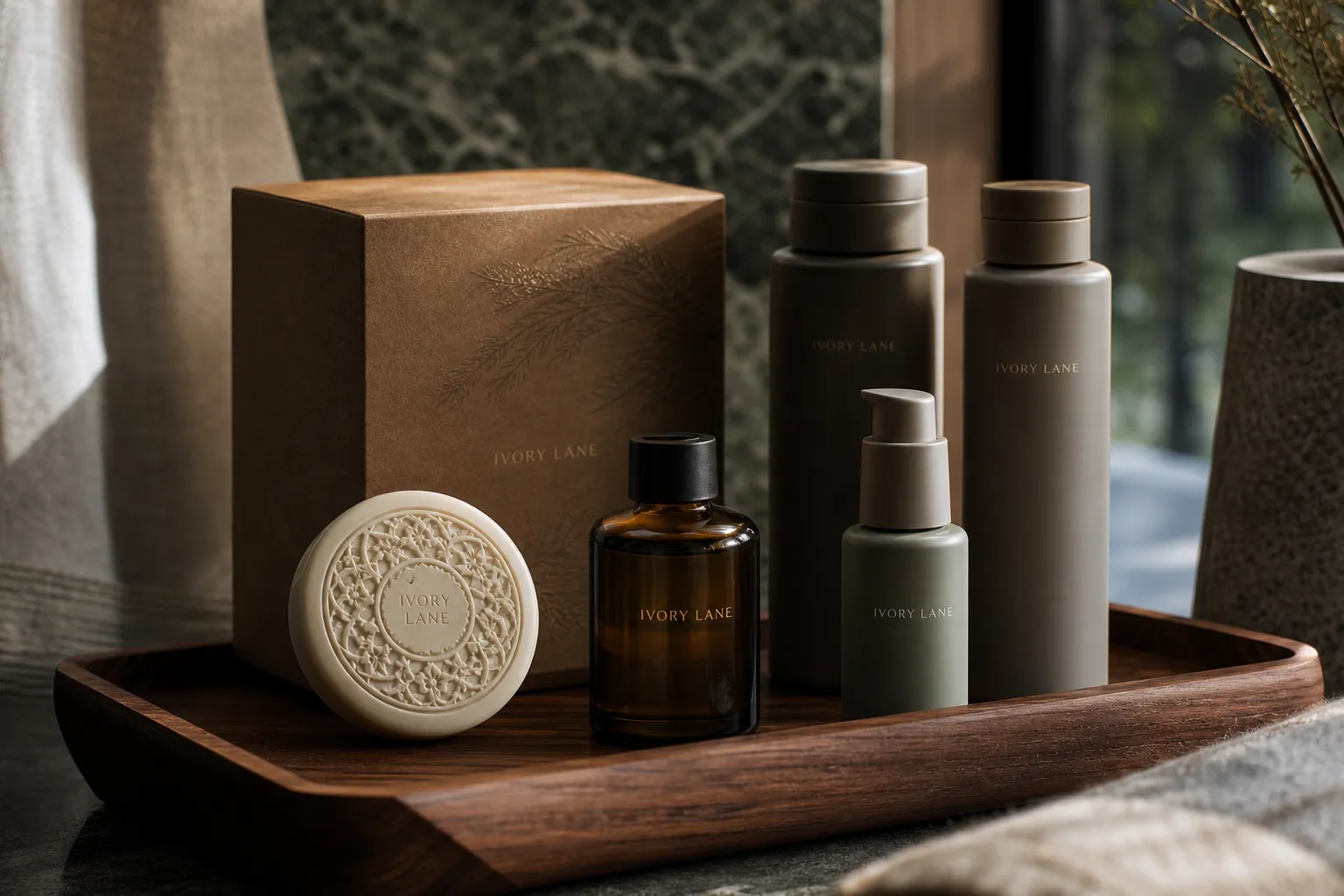
Most “unique hotel amenities” lists are written by people who have never priced one. They’ll suggest a pillow menu and a rooftop beehive and leave you no closer to a decision.
This one is written from the order side. We make amenities for hotels, so we can tell you which ideas are cheap and land well, which are expensive and land well, and which sound wonderful in a brainstorm and quietly get cut at the first budget review.
First: the rule that decides everything
An amenity is memorable when it’s specific, not when it’s expensive.
A guest cannot tell you what brand of shampoo was in their last four hotels. They can tell you about the one that smelled like their grandmother’s garden, or the one where the kids got their own kit, or the one where the soap had the hotel’s name pressed into it. The gap between those and the generic version is almost always smaller than the gap in how they are remembered.
Chase specificity. Everything below is a way to buy it.
Why some amenities get mentioned and others don’t
Three things have to line up before a guest describes an amenity to somebody else:
- It has to be noticed. Which usually means it sits where the guest’s hand goes, not where the housekeeping checklist says it looks tidiest.
- It has to be unexpected. Not better — different. A superb shampoo in a standard bottle is invisible; an ordinary soap with the hotel’s name in it is not.
- It has to be describable in one sentence. “They had soap with the hotel’s name pressed in it” survives a retelling. “The toiletries were high quality” does not.
Most amenity budgets fail the second and third tests while passing the first expensively. That is the whole diagnosis.
Ideas that cost almost nothing
1. Press your name into the soap. A custom-embossed die on a pleated or stamped bar is a one-off tooling cost and nothing extra per unit after that. It’s the single highest ratio of feels bespoke to actually costs money in this entire industry. Guests photograph it.
Since this is the idea we recommend most often, the detail matters. Emboss is a relief, so it reproduces mass and loses fine line — a wordmark in a solid weight presses cleanly, a hairline serif or a logo with an outlined counter fills in and turns to mush. Bring the simplest version of your mark you have, or make one for this purpose. Test it at the actual bar size rather than on screen: a 15 g bar gives you a fraction of the surface a 40 g bar does, and a mark that reads at 40 g can be unrecognisable at 15 g. Ask for a physical sample of the pressed bar, not a rendering.
2. Rename the products in your voice. “Wake” and “Wind Down” instead of “shampoo” and “body wash”. Costs a label revision. Changes how the whole bathroom reads.
3. Write one sentence on the back of the pack. Where the formula came from, what’s in it, why you chose it. Guests genuinely read amenity packaging — it’s the only text in the bathroom.
4. Put the amenity somewhere unexpected. A hand cream by the bed rather than the basin. A lip balm in the minibar drawer. Same unit cost, completely different reaction.
5. Match the scent across the range. Shampoo, conditioner, shower gel, soap and the room diffuser in one accord. This costs nothing extra at manufacture — it’s a formulation decision, not an ingredient upgrade — and it’s what makes a property smell like itself.
Ideas worth real money
6. A signature scent that runs from lobby to shower. The most effective brand investment in hospitality, and the one guests describe unprompted in reviews. Start with reed diffusers in rooms and one lobby unit, then extend the accord into the bath range. We cover the mechanics in why hotels smell so good.
7. A local-ingredient formula. Olive and citrus for a Mediterranean property, green tea for a Kyoto ryokan, argan for Morocco. This is real custom formulation — it takes development time and a higher MOQ — but it gives the amenity a story that no competitor down the road can copy. Our R&D team holds 1,000+ formulations and develops from a brief.
8. A proper kids’ set. Chronically under-served, and families notice instantly. Amino-acid based, additive-free, tear-free, in its own small pack. Our CHUEN RAIN line exists for exactly this. A family that finds a kids’ kit in the room tells other families.
9. A welcome kit for long stays. Serviced apartments and extended-stay properties see measurably better reviews when arrival includes a small kit — laundry detergent, dish soap, a sponge, a few basics — rather than an empty kitchen. See travel & vacation kits.
10. Seasonal editions. The same formula, a different label and scent twice a year. Repeat guests notice the change and read it as a property that pays attention. The cost is a label run, not a reformulation.
Ideas by property type
| Property type | The idea that works | Why |
|---|---|---|
| City business hotel | Shoe-shine sponge + a real pen | Practical, used, cheap |
| Boutique | Embossed soap + named products | Brand personality is the whole product |
| Resort | After-sun and insect-repellent wipes | Solves a problem the guest actually has |
| Spa | Matched treatment-room and retail range | Turns the amenity into a sales channel |
| Serviced apartment | Arrival kit + refill-on-request | Long stays need restocking, not a one-off |
| Airbnb / STR | A branded welcome kit in a kraft box | Photographs well; drives 5-star reviews |
| Family hotel | Kids’ bath set + bath toy | Under-served, disproportionate goodwill |
Ideas that sound better than they are
Being honest about these will save you a budget cycle.
- Anything electronic. Guests don’t want your branded phone charger; they want the one that fits their phone. Breakage and e-waste make it expensive twice.
- Elaborate multi-piece kits in economy rooms. The tier mismatch reads as odd rather than generous, and housekeeping time goes up.
- Premium amenities in every room. Concentrating spend in suites and running a good standard set elsewhere consistently outperforms spreading the same budget flat.
- Candles. Fire risk, insurance questions, and the scent is uncontrolled. A reed diffuser gives you the effect without the incident report.
- Fully bespoke fragrance on a first order. Development cost and lead time are real. Start with a stock accord modified to your brief, and go fully bespoke once the property has proven the programme.
- Anything that needs explaining. A solid shampoo bar with no instruction produces a guest who washes their hair with what they assume is soap and forms an opinion about your hotel. If an idea needs a card next to it, either write the card or drop the idea.
- An amenity that competes with the minibar. Anything edible or drinkable given free undercuts something you are trying to sell three feet away, and it is outside what an amenity supplier makes anyway.
- Too many good ideas at once. Six upgrades in one refit means you cannot tell which one worked, and the set stops reading as considered and starts reading as busy. One or two, done properly, beats six.
Briefing it properly
Once you have picked the idea, most of what goes wrong afterwards is a briefing problem rather than a manufacturing one. What a supplier needs from you, in rough order of how often it is missing:
Your logo in a single-colour version. Emboss, engraving and embroidery are all monochrome by nature. A full-colour logo with a gradient cannot be pressed into soap or stitched into a slipper upper, and discovering this after artwork approval costs a round of samples.
The room tier each item is going into. The same product specified for a suite and for a standard room are different orders. Say which is which up front.
Your average length of stay and occupancy. These set the sizes and the quantities. Without them any quote is a guess dressed up as a number.
What the item has to sit next to. An amenity is never seen alone. If the new soap will share a tray with an existing kit you are not changing, say so — matching to what stays is as important as the new item itself.
Any claim you need to be able to make. Vegan, sulfate-free, a specific material certification, a regulated market. These are formulation and sourcing decisions, not labelling decisions, and they have to be in the brief rather than added at the end.
What each idea actually costs you
We quote per project rather than from a price list, because unit cost moves with format, packaging, decoration method, volume and formula. What we can tell you is the shape of each cost — which ones are one-off, which recur per unit, and which are really a change in operations rather than a change in spend.
| Upgrade | Where the cost sits | Recurring unit cost |
|---|---|---|
| Embossed logo on soap | One-off die and tooling | None |
| Custom label and naming | One-off artwork and print plate | None |
| Matched scent across the range | Nothing — it is a formulation choice | None |
| Larger bottle format | None | Slight, scales with volume |
| Local-ingredient custom formula | R&D development plus a higher minimum | Modest |
| Reed diffuser in rooms | Unit plus a refill programme | Refills |
| Kids’ set in family rooms | A separate reference at full MOQ | Per family stay |
| Seasonal edition | A label run each season | None |
Two patterns fall out of that table.
The cheapest ideas are one-off costs, not per-unit costs. Embossing, naming and scent matching are paid once and then ride free on every unit for the life of the programme. If your budget is tight, these are where it goes.
The expensive part is rarely the product. It is the reference count. Custom-branded production starts at 5,000 units per item, per reference — so the practical constraint on most of these ideas is not cost per unit but whether you order enough of that reference to justify it.
The MOQ maths for a small property
A 60-key hotel at 65% occupancy turns over roughly 14,000 occupied nights a year. On a soap replaced every stay at an average 1.8 nights, that is around 8,000 bars — comfortably above the 5,000 minimum, so a custom soap is a single year’s supply.
Run the same maths on a vanity kit that only goes in 12 premium rooms and the picture inverts: a few hundred units a year against a 5,000 minimum is a decade of stock sitting in a storeroom.
That asymmetry is the whole rule. Customise the references that rotate fastest and are seen most; take the slow ones from catalogue. For most properties that means soap and shampoo branded, everything else stock. Our MOQ guide covers shared runs and group consolidation for the cases where that is not enough, and par levels and restocking has the rotation-rate detail.
Test it before you roll it out
Almost nobody does this, and it is the cheapest risk reduction available.
Take one floor, or one room category, and run the idea there for a quarter while the rest of the property stays on the standard set. Three things to watch:
- Review text, not review scores. A score will not move on an amenity change and looking for it will only make you conclude the idea failed. Search your review text for the item instead — the mention rate is the signal.
- Front-desk requests. A good amenity reduces them. A confusing one — a solid shampoo bar with no explanation, a dispenser guests cannot work out — increases them immediately.
- What housekeeping says. They handle every room every day and will know within a fortnight whether something is being used, ignored or thrown away unopened.
A quarter on one floor costs a rounding error and tells you more than any amount of internal debate. It also gives you the argument you need for the budget conversation, which is usually the real obstacle.
How to choose, in one paragraph
Take your standard amenity set and ask which single item a guest is most likely to describe out loud to somebody else. For most properties it’s the soap or the scent. Put your money there, make it specific to you, and keep everything else clean, competent and unremarkable. That beats spreading the same budget thinly across ten upgrades nobody registers.
Frequently asked questions
What are some unique hotel amenities?
The ones that work are specific rather than expensive: soap embossed with the hotel’s name, a signature scent running from lobby to shower, a local-ingredient formula, a proper kids’ set, and an arrival kit for long stays. Novelty items and electronics tend to disappoint relative to cost.
What amenities do guests value most?
Bath products they’d actually use at home, a comfortable slipper, and anything that solves a problem they arrived with — after-sun at a resort, laundry detergent on a long stay, a dental kit they forgot to pack. Guests rate usefulness far above quantity.
How much do custom hotel amenities cost?
We quote per project, because unit cost moves with format, packaging, decoration method, volume and formula. The useful thing to know is the shape rather than the number: embossing, naming and scent matching are one-off setup costs that then ride free on every unit, while custom formulation carries both development work and a larger minimum. Send room count, tiers and average occupancy and we will size it properly.
How do I test an amenity idea before committing?
Run it on one floor or one room category for a quarter. Watch review text for mentions rather than review scores, watch whether front-desk requests go up or down, and ask housekeeping — they will know inside two weeks whether it is being used or binned.
Can a small hotel get custom amenities?
Yes, within limits. At 5,000 units per item, a 60-room property can comfortably custom-brand one or two high-impact SKUs — usually soap and shampoo — while using stock lines for the rest. Trying to customise the entire range at that size is where budgets break.
What amenities do families want?
A separate kids’ bath set, tear-free and additive-free, in its own pack. It’s one of the most under-provided amenities in the industry and one of the most reliably mentioned in reviews by families.
How often should we change our amenities?
The core range should stay stable — recognition is the point. Seasonal or annual label and scent editions give you freshness without losing the identity you’ve built.
Want to work through which one or two SKUs to customise? Request a quote with your room count and property type. You can also explore customization options or browse the full product range.