guides
Guest Amenities in Housekeeping: Par Levels & Restocking
UMYAN · Aug 14, 2026
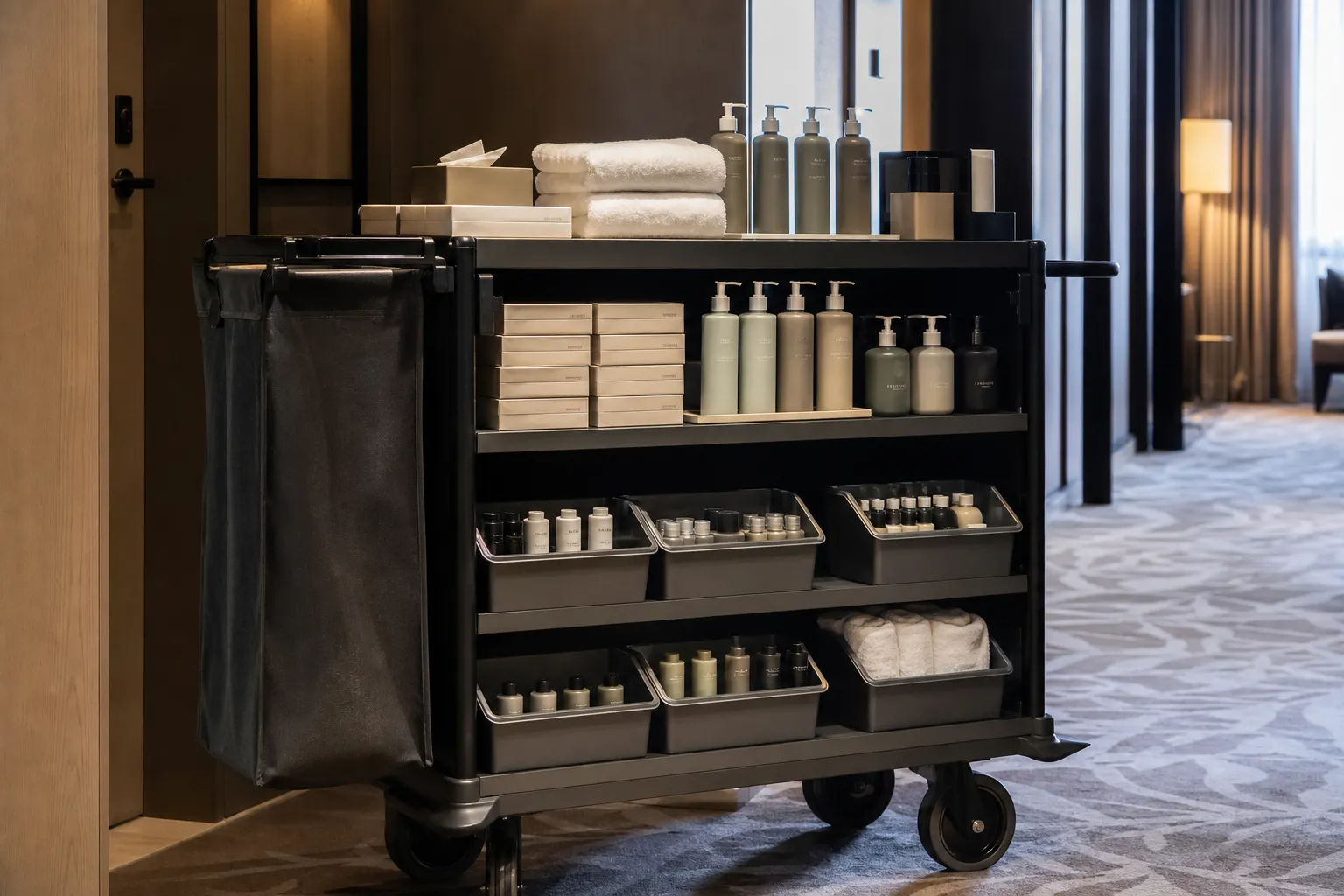
In housekeeping terms, guest amenities are the consumables replaced between stays — the bath line, the dry kits, slippers and the small in-room sundries. Everything that leaves with the guest or gets thrown away, as distinct from linen, which gets laundered, and from fixtures, which get cleaned.
Most amenity guides are written for the buyer. This one is written for the person who has to stock the trolley, because that’s where the cost actually behaves.
The standard list by area
| Area | Items |
|---|---|
| Bathroom | Shampoo, conditioner, shower gel, body lotion, bar soap, hand wash, dental kit, shaving kit, vanity kit, comb, shower cap, mouthwash |
| Bedroom | Slippers, laundry bag, sanitary bag, sewing kit, shoe bag |
| Desk | Pen, notepad, coaster, glass cover |
| Public areas | Hand wash and dispensers, wet wipes, sanitary bags |
Not every property carries every line. What matters for housekeeping is that the list is fixed and written down — a set that varies by who is cleaning the room is a set you cannot forecast, and forecasting is the whole game.
The full buyer-side list is in hotel amenities list; the by-tier version is in hotel bathroom amenities.
Par levels: the actual math
A par level is how many units you hold so you never run out between deliveries. The mistake is setting it per room. Set it on occupied nights:
Monthly usage = keys × occupancy × 30 × units per stay ÷ average length of stay
Par level     = monthly usage × (lead time in months + safety buffer)
Two things fall out of that formula immediately:
Occupancy is the multiplier, not room count. A 200-key hotel at 60% occupancy consumes what a 120-key hotel at 100% consumes. Buying per key at 60% occupancy means holding roughly 1.6× the stock you need — money sitting in a storeroom.
Length of stay changes everything about the bathroom line. One guest staying four nights uses far less shampoo than four guests staying one night each, because most of the consumption happens on arrival. Two properties with identical occupancy and identical room counts can differ by a third on bath-line spend purely on average length of stay.
Restock rates are not equal
This is the single most useful thing to internalise, and it’s why blanket reordering fails:
| Item | Rotation | Note |
|---|---|---|
| Dental kit | Fastest | The most-forgotten item; also the most common front-desk request |
| Shampoo / gel | Fast | Arrival-heavy consumption |
| Bar soap | Fast | Replaced whether used or not |
| Slippers | Medium | Often taken home — that’s the design, not a loss |
| Shaving kit | Medium | Skews to business guests |
| Vanity kit | Slow | Premium rooms only, low take-up |
| Sewing kit | Slowest | Can sit for months |
Order these in equal proportion and you end up with dead sewing-kit stock and dental-kit stockouts in the same storeroom. Track them as separate lines with separate reorder points.
Practical check: if your sewing kits have been in the store more than six months and your dental kits have run out even once, your order ratios are wrong — not your budget.
The trolley and the storeroom
Two operational details that decide whether the numbers hold:
Decant point. Bulk refills (1L, 3.78L, 5L) belong back-of-house, not on the trolley or in the guest bathroom. Refilling in the room is slower, messier and reads badly if a guest walks in. Refill dispensers in a service area and rotate the units.
Storage conditions. Paper-based packaging — kraft sleeves, sugarcane boxes, card boxes — absorbs damp. A store room next to a laundry will soften and mark boxes long before the contents expire, and a marked box gets binned. If your storage is humid, that is an argument for sealed packaging, and it belongs in the purchase decision rather than being discovered later.
Where the cost leaks
In order of how much money we see wasted:
- Oversized bottles for short stays. A 40 ml bottle on a one-night stay gets thrown away half full. This is usually the largest single leak, and it’s fixed at purchase, not in operations. See hotel toiletry sizes and formats.
- Same set in every tier. Convenient to manage, expensive to run, and it removes the visible difference between a standard room and a suite.
- Buying per key instead of per occupied night.
- Replacing whole kits that were never opened. For sealed boxes in a stayover clean, check before replacing. For anything unsealed or handled, replace it.
- Split suppliers across one set. The whites don’t match between vendors, and the scents fight each other. It saves on the invoice and shows in the room.
Per-room cost modelling is covered in hotel amenities cost per room.
What this means for ordering
Custom-branded amenities start at 5,000 units per item — per SKU, not per order. That interacts with par levels in a way worth planning for: a slow-rotating item like a sewing kit at 5,000 units may represent two years of stock for a small property, sitting in a humid storeroom the whole time.
Two sensible responses: brand only the fast-rotating, high-visibility items and take the slow ones unbranded from catalogue, or consolidate the order across properties in the same group.
Request a quote with key count, average occupancy and average length of stay, and we’ll size the order against your actual rotation rather than your room count.
Frequently asked questions
What are guest amenities in housekeeping? The consumables replaced between stays — bath line, dry kits, slippers and in-room sundries. Linen is laundered rather than replaced, so it’s tracked separately.
How do you calculate amenity par levels? From occupied nights, not room count: keys × occupancy × 30 × units per stay ÷ average length of stay gives monthly usage; multiply by lead time plus a safety buffer.
Should unopened amenities be replaced on a stayover clean? Sealed, untouched boxes can stay. Anything unsealed, handled or in the shower gets replaced. Set the rule explicitly, or it varies by attendant.
Which amenity runs out fastest? The dental kit, in almost every property. It’s also the item most likely to become a front-desk request, so a stockout costs staff time as well as goodwill.
Where should bulk refills be stored? Back-of-house. Refill dispensers in a service area and rotate units into rooms; never refill in a guest bathroom.
Sizing an amenity order against real occupancy? Send us key count, occupancy and average length of stay and we’ll work the quantities with you. See all product families or get in touch.