guides
Resort & Spa Amenities: Planning for Longer, Higher-Use Stays
UMYAN · Jun 11, 2026
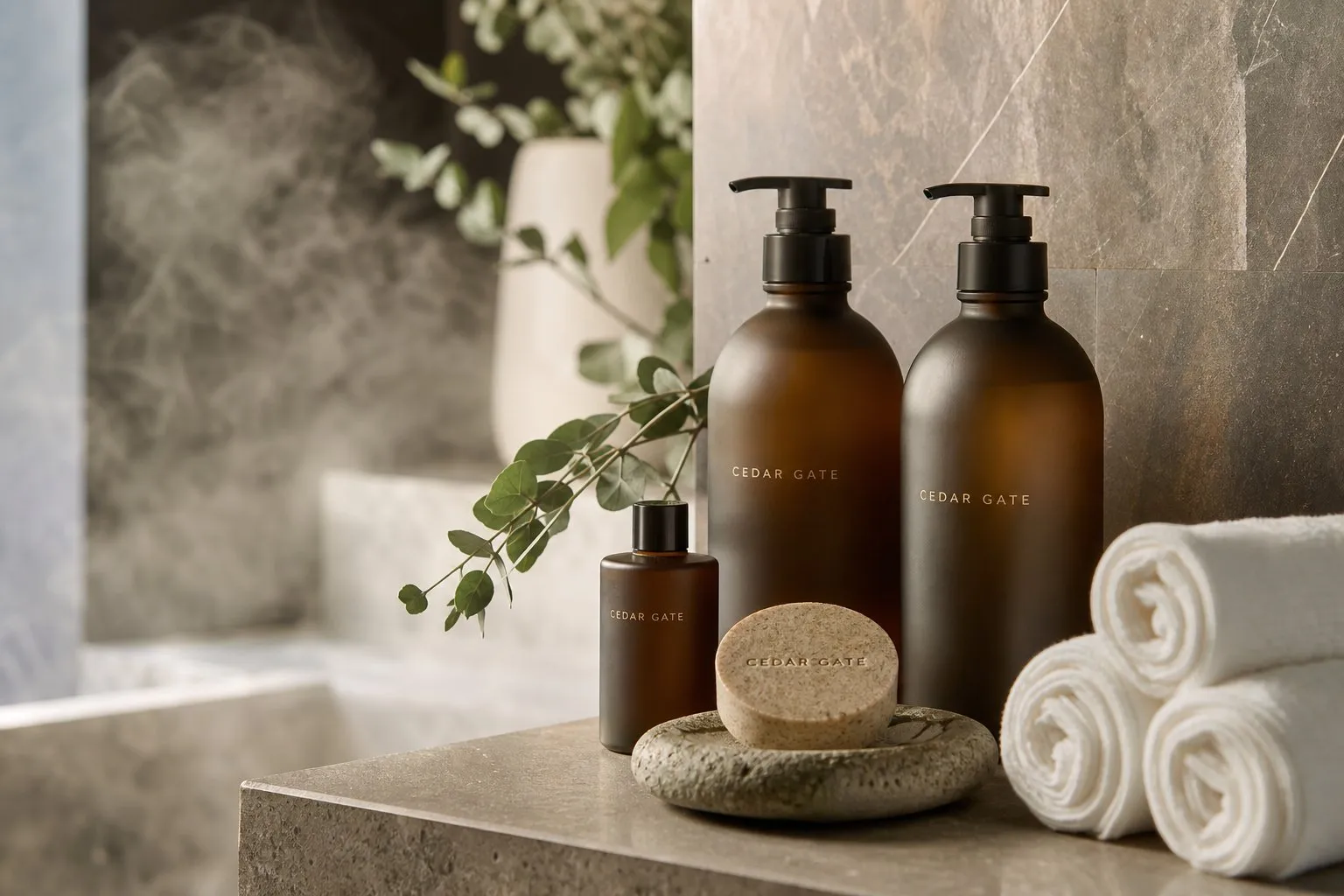
Resort and spa guests stay longer and use more, so the amenity plan shifts toward larger sizes, more body care, and a scent that carries the spa experience into the room. Where a city hotel optimizes for a one-night stay, a resort plans for a week of heavier use across more spaces — rooms, pool, gym and treatment rooms.
We supply resorts and spas in 40 countries, so here’s how the planning differs from a standard hotel. It’s part of our amenities by property type series.
Plan per stay, not per night
The single biggest difference is volume per guest, and the mistake that follows from ignoring it is the one we see most often at resorts.
A city hotel plans amenities per occupied night because its guest arrives, showers once, and leaves. A resort guest showers after the beach, again after the pool, again after a treatment, and is in and out of the bathroom for six days. Consumption is not proportional to nights — it is closer to proportional to activities, and a resort generates several per day.
Two consequences:
Size up or go refillable. A 30 ml bottle that comfortably serves a one-night city stay is empty on day two of a resort stay, and the guest either calls housekeeping or forms an opinion about how generously the property is run. 40 ml and above, or a refillable format in the shower.
Body care outruns hair care. This inverts the city-hotel ratio. Sun, salt water, chlorine and air conditioning all drive lotion use, and at a beach or pool property body lotion is consumed faster than shampoo. Order the ratio you will actually use, not the standard set ratio.
See the bath & body range for the sizes and formats that suit longer stays, and par levels and restocking for the ordering method.
Replenish, don’t just replace
At a city hotel housekeeping swaps the set between guests. At a resort the same guest is in the room for a week, so the routine has to be top-up during the stay — checking on the stayover clean rather than only on departure.
This is a training point more than a purchasing one, and it is where a well-specified resort set most often fails in practice. The bottles were the right size; nobody checked them on day four.
Let the spa lead the scent
At a resort or spa, scent isn’t a detail — it’s part of the product. A signature fragrance that runs from the spa through the rooms and public areas makes the whole property feel like one coherent experience.
Match the scent across room fragrance and the bath line so a guest who loved the treatment-room smell finds it again in their bathroom. With our Givaudan fragrance partnership, that scent can be developed specifically for your property.
Buying tip: Build the scent around the spa first, then carry it outward. The spa is where guests are most scent-aware, so a fragrance designed for the treatment room will feel intentional everywhere else too.
One property, five different specifications
A city hotel has guest bathrooms and maybe a lobby washroom. A resort has five or six distinct environments, and specifying them identically is how properties end up with empty dispensers at the pool and untouched product in the treatment rooms.
| Space | Format | Why it differs |
|---|---|---|
| Guest bathroom | 40 ml bottles or in-shower dispenser | Long stay, one guest, replenished during the stay |
| Pool and beach showers | Stainless locking dispensers, 500 ml, bulk-fed | Highest churn on the property; individual bottles disappear immediately |
| Gym showers | Same, but sized for a morning peak | Consumption is spiky, not steady — size for 07:00, not for the daily average |
| Treatment rooms | Larger body care and oils in the spa scent | Applied by a therapist, not the guest; volume and dispensing differ entirely |
| Spa changing rooms | Dispensers plus slippers with a thicker sole | Wet feet on hard wet floor — this is a safety spec, not a comfort one |
The through-line is that one scent should run across all of them while the format changes at every stop. That is achievable because the same formula can be supplied in a 40 ml bottle, a 5 L bulk refill and a 150 ml reed diffuser. The public-area detail is in hotel washroom amenities.
The slipper spec is a safety decision here
At a city hotel a slipper is a comfort item. At a resort, guests walk wet from the pool, across tile, into a changing room, and a thin sole on a wet hard floor is a liability rather than a saving.
Terry or coral fleece for absorbency, and a thicker sole than the 6–7 mm guest-room standard for anything in a wet zone. Add kids sizes (22–26 cm) if you take families — a child dragging adult slippers across a wet pool deck is the exact failure this spec exists to prevent. Materials and construction are in hotel slippers.
Make it sustainable at scale
Resorts generate a lot of waste simply because of volume, which makes the sustainability win bigger here than anywhere. Refillable dispensers in pool, gym and public areas, paper-packaged kits and solid bars from the eco line cut a meaningful amount of plastic — and resort guests increasingly expect it.
One caveat specific to coastal and tropical properties: paper-based packaging and humidity are a bad combination. Kraft sleeves and sugarcane boxes soften and mark in a damp storeroom long before the contents expire, and a marked box gets binned. If your store is not climate-controlled, either specify sealed packaging for the paper-based items or keep the eco program in the shower — where the refillable formats live — rather than in the drawer.
What we supply, and what you will source elsewhere
Worth being explicit, because a resort brief usually spans more than one supplier and it is easier to say so than to let a buyer assume.
Ours: the bath and body line, soap, mouthwash, amenity kits and dry goods, slippers, dispensers and bulk refills, room fragrance, wet wipes and room accessories, and the paper-based eco line.
Not ours: robes, towels, bath mats, sunscreen and after-sun, hand sanitiser, tissues and paper goods, and the HVAC-integrated scent systems used to fragrance large open lobbies. These are all normal parts of a resort program — they simply come from other vendors, and any supplier claiming to cover the whole list from one catalogue is worth a second look.
Where this matters practically: the robe and the slipper are seen as a pair by the guest but bought from two suppliers, so match them deliberately. Terry slippers against a terry robe works; a velvet slipper against a waffle robe reads as an accident.
A worked example: a beach resort
Here’s how we’d typically plan a mid-size resort:
- Build the scent around the spa first, then carry it through rooms, lobby and pool areas so the property feels like one experience.
- Size up the bath line to 40ml or refillable, and shift the ratio toward body lotion — sun, salt and chlorine drive lotion use past shampoo at a beach property.
- Convert pool, gym and public showers to locking dispensers on bulk — the highest-churn spaces, and the biggest waste and cost saving.
- Keep branded bottles in suites for the premium in-room moment.
- Plan replenishment around multi-night stays, so housekeeping tops up rather than finding empties.
The exact sizes, formats and pricing come back on a quote against your room count and facilities.
The spa retail tie-in
This is the one place in hospitality where the amenity can stop being a cost line and start being a revenue line, and most spas leave it on the table.
A guest who spends ninety minutes with a product on their skin and likes it is the warmest possible buyer for that product. If the treatment-room oil and the guest-room bath line share a scent, and a retail size exists at the desk, a proportion of guests will buy it — and the ones who do carry the scent home and remember where it came from.
Two practical constraints before you plan on it:
Retail sizes are separate references. A 40 ml guest bottle and a 250 ml retail bottle are two different items against a 5,000-unit minimum each. For a single spa that can be a lot of stock; for a group running the same scent across several properties it is straightforward.
Retail packaging has to survive a suitcase and a shelf. Guest-room packaging is designed to be used once in a bathroom. A retail bottle sits under shop lighting next to other brands and then travels home in luggage — different label stock, different closure, different expectations.
Start by testing demand with a small retail presence before committing to a full retail reference. If the treatment therapists are already being asked what the oil is, you have your answer.
Seasonality changes the ordering, not the spec
Most resorts run occupancy swings a city hotel never sees — a full house in season and a fraction of it out of season, sometimes with a closed period.
Two things follow:
Order against the season, not the annual average. An annual average smooths away exactly the peak you need to be stocked for, and a stockout in peak week is the one that costs you.
Watch shelf life against a closed season. Product bought for a peak and held through a quiet period is fine for dry goods, and worth checking for anything with a formulated shelf life. Ask for the shelf life in writing at order time rather than assuming it.
Frequently asked questions
How are resort amenities different from hotel amenities?
Resort guests stay longer and use more, so plan for higher consumption: larger or refillable bath sizes, a ratio weighted toward body lotion, durable slippers with a thicker sole for wet areas, and a scent that ties the spa to the rooms. Plan per stay rather than per night.
What amenities should a spa provide?
A spa should carry its signature scent across treatment-room body care, oils and the bath line, plus generous body care and comfortable slippers. Consistency of scent is what makes the experience feel designed.
What sizes are best for resorts?
40ml and larger, or refillable formats, so guests on multi-night stays don’t run out. Many resorts use larger bottles in rooms and dispensers in pool and gym areas.
Can the room scent match the spa?
Yes. With in-house fragrance development (Givaudan partnership), we can build one signature scent and match it across the spa, the room fragrance and the bath line.
Do you supply robes, towels and sunscreen?
No. Robes, towels, bath mats, sunscreen and after-sun, hand sanitiser and paper goods come from other vendors. Our resort scope is the bath and body line, soap, mouthwash, kits and dry goods, slippers, dispensers and bulk, room fragrance and room accessories. Worth planning the robe and slipper together even though they come from two suppliers, since the guest sees them as a pair.
What slipper should a spa use?
Terry or coral fleece for absorbency, on a sole thicker than the 6–7 mm guest-room standard, because spa and pool guests walk wet on hard wet floors. Add kids sizes if you take families.
How do I order for a seasonal resort?
Against the peak season rather than the annual average — an average smooths away the week you most need to be stocked for. Check shelf life in writing for anything held through a closed period.
Can guests buy the spa products?
That is the retail tie-in, and it works when the treatment product and the guest-room line share a scent. Note that a retail size is a separate reference at full minimum order, so test demand before committing to it.
Planning amenities for a resort or spa? Request a quote with your room count and facilities, and we’ll plan sizes, body care and a spa-matched signature scent for the way your guests stay.