guides
Hotel Room Accessories: The Amenities Nobody Specs Until They Run Out
UMYAN · Aug 4, 2026
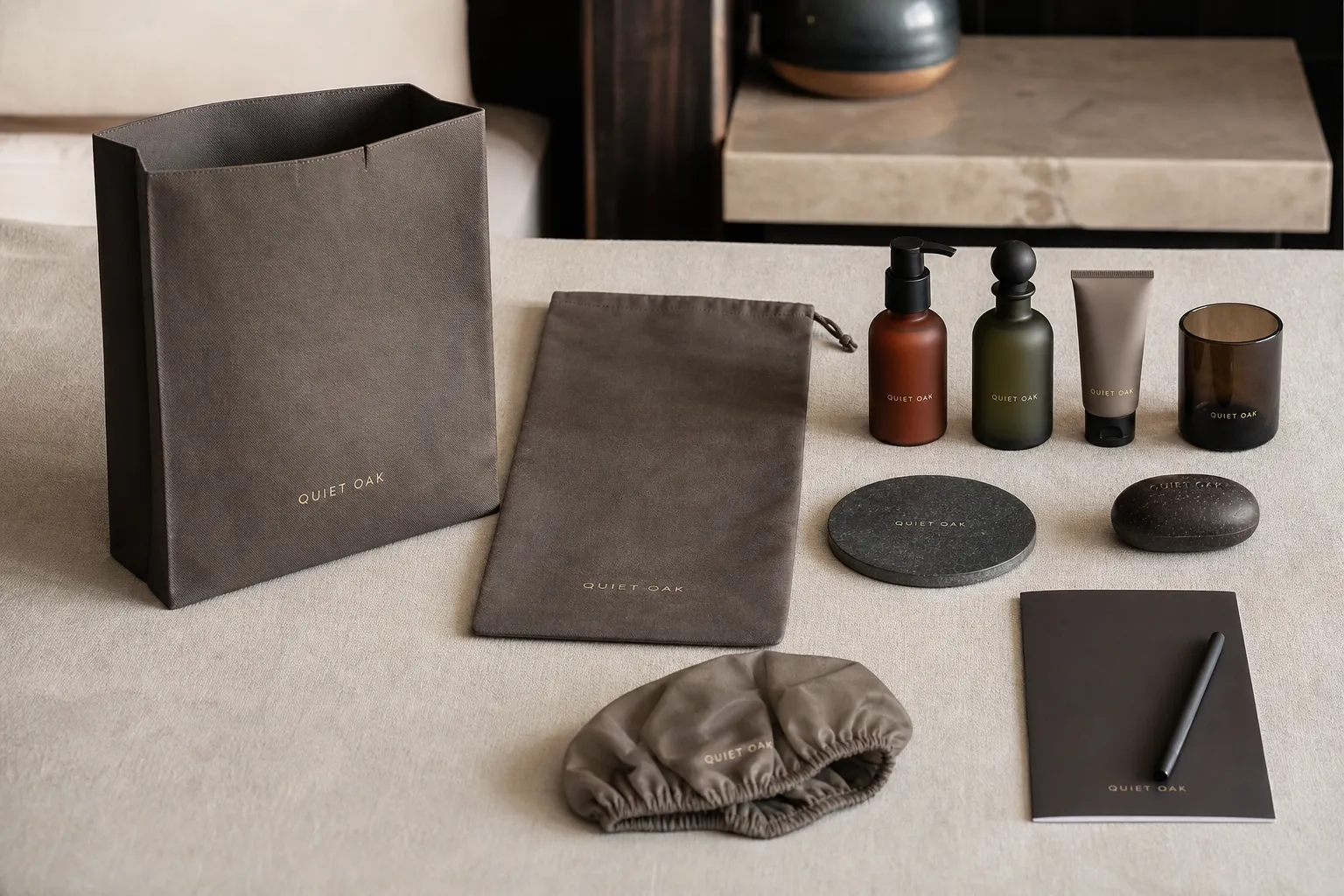
Every amenity tender we see specifies the shampoo in detail and treats the rest as a footnote. Then six months in, housekeeping is out of laundry bags, somebody buys 5,000 of the wrong ones from a local supplier, and the room has a mismatched bag in a wardrobe that was otherwise carefully designed.
Room accessories are low-value per unit and high-frequency in use, which is exactly the combination that gets under-planned. Here’s how to spec them properly.
The list, with what actually matters
| Item | Where it lives | Typical usage | Spec that matters |
|---|---|---|---|
| Laundry bag | Wardrobe | ~15–25% of stays | Material, whether it stands open |
| Shoe bag / shoe mitt | Wardrobe | ~10% of stays | Pairs with the laundry bag visually |
| Shower cap | Bathroom / vanity kit | ~10–15% of stays | Elastic quality, pack format |
| Sanitary bag | Bathroom bin | Restocked every stay | Opacity, discreet print |
| Wet wipes | Bedside, kit, or minibar | Varies widely | Sachet seal, alcohol content |
| Pen | Desk | ~30% taken home | Weight — it’s a brand carrier |
| Notepad | Desk | ~20% used | Paper stock, binding |
| Coaster & cup cover | Desk, tray | Every stay | Absorbency, board thickness |
| Slipper socks | Premium rooms | Per stay | Grip sole |
The usage figures are indicative — they move a lot with property type, length of stay and climate. But the shape holds: laundry bags and coasters move far faster than most buyers assume, and shower caps far slower.
Laundry and shoe bags
The most-used accessory in the wardrobe and the one most often bought badly.
Materials, in order of cost:
- Paper / kraft — cheapest, fully recyclable, and increasingly the default where plastic is being phased out. The weakness is wet items; a paper bag with a damp towel in it fails.
- Non-woven (PP) — the current workhorse. Light, holds shape, handles damp, prints well, cheap enough to be single-stay.
- Cotton / canvas — reusable, premium feel, genuinely nice. Guests take these home, which is the point in a luxury room and a cost problem anywhere else.
- Mesh / drawstring — used where the property runs a valet service and the bag returns.
The detail that separates a good bag from a bad one is whether it stands open on the wardrobe floor. A flat bag that collapses gets ignored; guests pile clothes next to it. A gusseted base costs marginally more and changes the behaviour entirely.
Shoe bags should visually match the laundry bag. It’s a small thing, but a mismatched pair in an open wardrobe is one of those details that quietly reads as cheap without the guest being able to say why — the same logic that applies to shoe care in the wardrobe.
Buying tip: order laundry bags at a higher ratio than you expect. They’re the accessory housekeeping runs out of first, and a stockout means an empty wardrobe hook in a room you’re charging full rate for.
Shower caps
Low usage, near-universal provision. Nobody upgrades a hotel for its shower cap, but its absence in a 4-star bathroom gets noticed.
Two decisions: the pack and the elastic. Flat sachets are cheapest and fit inside a vanity kit; small card boxes look better on an open shelf. On the cap itself, the failure mode is always the elastic — a cap that won’t hold is worse than no cap. Ask for a sample and stretch it.
Frosted or clear PE remains standard. Where plastic is restricted, look at biodegradable film — the performance is now close enough that most guests can’t tell. See shower cap types and specs for the packaging and elastic detail that actually decides quality.
Sanitary bags
The most quietly important item on this list. It is restocked every stay, it’s a hygiene expectation rather than an amenity, and getting it wrong is a genuine complaint generator.
Spec for opacity first — a semi-transparent bag defeats its purpose. Paper-based bags have largely replaced plastic here and perform well. Keep the print discreet; this is not a branding opportunity, and treating it as one is a mistake.
Wet wipes
The most flexible item in the range, because where you put it changes what it is. By the bed it reads as thoughtful. In the welcome kit it reads as practical. In a resort with an outdoor pool it’s close to essential.
Spec points:
- Sachet seal. A single-wipe sachet that dries out on the shelf is wasted money. Check the seal integrity, not just the wipe.
- Alcohol or alcohol-free. Alcohol-free for face and hands and for kids; alcohol for a sanitising claim. Don’t blur the two.
- Scent. If you run a signature accord, the wipe should match it or be unscented. A competing fragrance is worse than none.
See hotel wet wipes for formats, or which types suit which property for the fuller buying logic.
Pens, notepads, coasters
These three are brand carriers rather than amenities, and they’re worth thinking about as marketing spend.
Pens are taken home by roughly a third of guests, which makes them one of the cheapest brand impressions in the building — but only if the pen is worth keeping. A pen that writes badly gets binned at the airport. Spend the extra cents on weight and a decent refill.
Notepads matter more in business hotels than anywhere else. Paper stock is the whole impression.
Coasters and cup covers are used every single stay, which puts them among the highest-frequency touchpoints in the room. Board thickness is what separates a coaster that absorbs a ring from one that welds itself to the base of the cup — and the coaster usually doubles as the glass cover, not a separate item.
How to spec the whole set at once
Three rules that prevent the mismatched-wardrobe problem.
1. Buy the set together, not item by item. Laundry bag, shoe bag, sanitary bag and coaster should share a material family and a print treatment. Buying them from four suppliers at four times guarantees they won’t.
2. Set par levels from real usage, not from room count. Laundry bags and coasters move several times faster than shower caps. Ordering equal quantities of each means over-stocking one and running dry on the other — the most common accessories mistake there is.
3. Decide your material policy once. If you’re moving away from plastic, move the whole accessory set together. A kraft laundry bag next to a PE shower cap and a plastic sanitary bag sends a confused message, and it complicates your waste reporting. Our eco line covers the paper-based versions of most of these.
What this costs
Room accessories typically account for a small share of total amenity spend — well under what the bath range costs — but they’re a disproportionate share of housekeeping stockout incidents, because they’re ordered as an afterthought.
Custom-branded production starts at 5,000 units per item, which for most accessories is comfortably inside a single year’s usage even at modest room counts. That means custom print is realistic on this category for far smaller properties than it is on bath products.
Frequently asked questions
What accessories should a hotel room have?
At minimum: a laundry bag, a sanitary bag in the bathroom, a shower cap, a pen and notepad, and coasters. From 4-star upward add a shoe bag or shoe mitt, wet wipes, and slipper socks or slippers in premium rooms.
Are hotel laundry bags free to take?
Yes. Laundry and shoe bags are single-stay items, replaced between guests, so they’re free to take home. Cotton or canvas bags in luxury rooms are occasionally reusable — ask if you’re unsure.
What material are hotel laundry bags made of?
Most are non-woven polypropylene or paper/kraft. Non-woven handles damp items and holds its shape; kraft is fully recyclable and preferred where single-use plastic is being phased out. Cotton and canvas are used in luxury rooms as a reusable option.
How many laundry bags does a hotel need per room per year?
It depends on occupancy and length of stay, but plan for use in roughly a fifth to a quarter of stays rather than one per room. Laundry bags are the accessory housekeeping most often runs out of, so build a buffer into the par level.
Can room accessories be custom branded?
Yes, and this category is easier to customise than most because the setup costs are low. Print on non-woven and paper bags, coasters, notepads and pens is straightforward, with production typically starting at 5,000 units per item.
Should sanitary bags be plastic or paper?
Paper-based bags have become the standard and perform well. The critical specification is opacity, not material — a bag you can see through fails at its only job.
Speccing a full accessory set? Request a quote with your room count and we’ll build a list with par levels. Browse room accessories or the eco line for paper-based versions.