guides
What's in a Hotel Dental Kit (and How to Spec One)
UMYAN · Aug 18, 2026
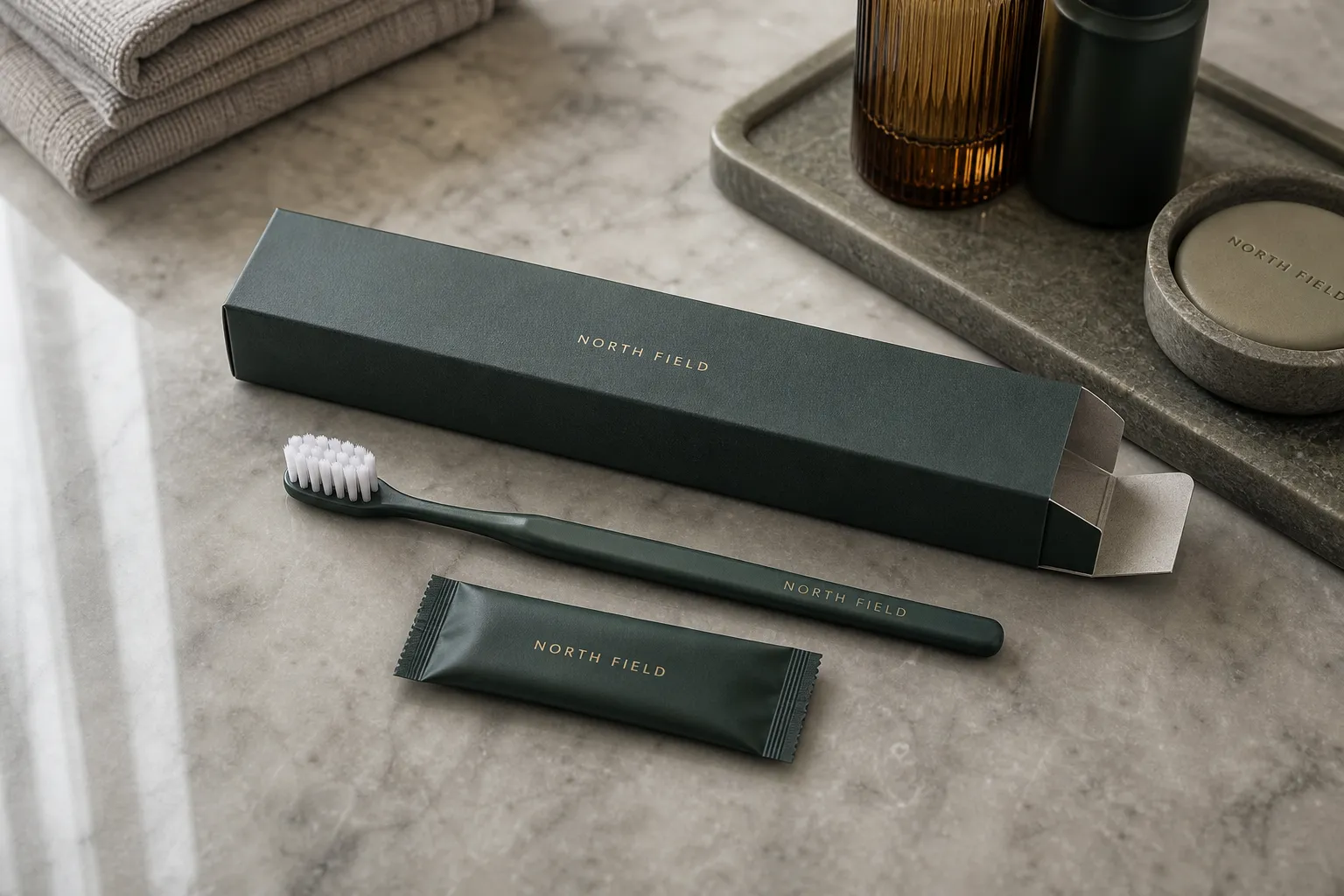
A hotel dental kit contains a toothbrush and a sachet of toothpaste, individually wrapped. That is the whole standard set — anything else is a property choosing to add to it.
That sounds too simple to need an article, and the contents genuinely are simple. What is not simple is the specification: three choices inside that two-item kit decide whether a guest reads it as thoughtful or as the cheapest object in the bathroom. We have been packing these since 2013, so here is what actually goes into speccing one.
The contents, by tier
| Tier | What’s in it |
|---|---|
| Standard | Toothbrush + toothpaste sachet, individually wrapped |
| Upper-midscale | The above, with a better filament and a printed box rather than a sachet |
| Premium / 5-star | The above, sometimes with floss or a small mouthwash alongside |
Two notes on the premium column, because both are commonly misunderstood.
Floss is not standard anywhere, and adding it is a real decision rather than an upgrade you get for free — it is a separate component with its own cost and its own packaging line.
Mouthwash is a separate item, not part of the dental kit. It ships in its own 30 ml bottle and sits beside the kit rather than inside it. Properties that want both should specify them as two references.
The three specs that actually matter
1. Filament grade — the one guests feel
Filaments come in super-soft, soft and medium. The cost difference between them is small. The experience difference is not.
A medium filament on a courtesy toothbrush is the fastest way to remind a guest that the item was free. Super-soft from four stars upward; soft is a reasonable floor anywhere. This is the single spec we would tell a buyer not to economise on, because it is the only part of the kit the guest physically feels.
2. Handle material — where the tier and the eco story both show
| Handle | Reads as | Notes |
|---|---|---|
| White plastic | Standard, neutral | The default; invisible in a good way |
| Black plastic | Considered, design-led | Works in dark or minimal bathrooms |
| Kraft paper | Eco-aligned | Fits a plastic-reduction programme without changing anything else |
| Bamboo | Natural, premium-eco | Heavier in the hand, which reads as quality |
Paper and bamboo handles are the cheapest way to put a visible sustainability signal in the bathroom, because the guest holds the object and notices the material immediately. If you are running a wider eco programme, this is a better first move than most — see eco / biodegradable amenities.
3. Packaging — carries the tier more than the contents do
The same toothbrush and sachet read as four different price points depending on what they arrive in:
| Packaging | Reads as |
|---|---|
| Sachet | Functional, budget |
| Kraft sleeve | Natural, eco-aligned |
| Card box | The hotel standard |
| Sugarcane paper box | Documented eco programme |
| Antibacterial pouch | Hygiene-led |
This is what makes same contents, different box by room tier the most efficient pattern in the drawer: you buy the contents in volume, which helps with minimums, and differentiate only where the guest looks.
What it is not
Worth stating plainly, because these get mixed up on tender documents and the confusion changes what you are quoted:
| It is not | That set is |
|---|---|
| A shaving kit | Razor + shaving cream sachet |
| A vanity kit | Cotton buds, cotton pads, nail file |
| A cotton kit | Cotton buds and pads only |
| A travel or welcome kit | A multi-item set assembled for a whole stay |
Put the contents list in the tender rather than the kit name. “Toothbrush ×1, toothpaste sachet ×1, boxed” removes all ambiguity; kit names vary by supplier and by market.
Placed in the room, or kept at the desk?
This decision changes annual spend more than any spec choice does, and the answer is regional.
Placed means a kit sits in every room and is replaced when used. On request means the kits live behind the front desk. Across most of Asia dental kits are placed as standard; across most of Europe and North America they are held at reception.
The arithmetic is straightforward. A placed kit is discarded whether or not it was used, because a box that has sat in a bathroom cannot be given to the next guest. An on-request kit is consumed only when someone asks.
But two things push the other way:
The dental kit is the most-forgotten item in travel. It is also the single most common front-desk request in this category, and a request costs staff time as well as goodwill.
Never hide a kit your market expects to see. If your guests are used to finding one in the room, keeping it at reception reads as cost-cutting and it will show up in reviews. Regional conventions are covered in what hotels actually provide.
How many to order
Dental kits rotate faster than anything else in the dry-goods family — faster than shaving, far faster than sewing or vanity. That has two consequences for ordering.
Order against occupied nights, not room count. At 65% occupancy, buying per key means roughly 1.5× the stock you need sitting in a storeroom.
Give it its own reorder point. The usual failure is ordering the whole kit range in equal proportion, which leaves you with dead sewing-kit stock and dental-kit stockouts in the same cupboard. The method is in par levels and restocking.
Custom-branded production starts at 5,000 units per item, per reference. For most properties the dental kit is the first item that clears that minimum comfortably, which also makes it the sensible first candidate for branding — it is the kit guests handle most.
Artwork and physical samples are provided before production. Pricing is quoted per project, since it moves with filament, handle, packaging and volume. Request a quote with your room count and average occupancy.
Frequently asked questions
What’s in a hotel dental kit? A toothbrush and a sachet of toothpaste, individually wrapped. Some premium kits add floss; mouthwash is a separate item rather than part of the kit.
Do hotels provide toothpaste? Most do, either placed in the bathroom or available at reception. It is placed as standard across most of Asia and more often held at the front desk in Europe and North America.
What size is the toothpaste in a hotel dental kit? A single-use sachet sized for a short stay rather than a tube. Properties with longer average stays sometimes specify a small tube instead.
Is mouthwash part of the dental kit? No. It is a separate reference, usually a 30 ml single-use bottle with alcohol-free options, placed alongside the kit.
Which toothbrush filament should a hotel use? Super-soft from four stars upward, soft as a floor anywhere. Medium is the one spec choice guests physically notice, and not in a good way.
Can we brand the dental kit? Yes — the box or sleeve, the toothpaste sachet, and the handle colour and material. Custom production starts at 5,000 units per item with free artwork and samples.
How many dental kits should we order? Calculate on occupied nights rather than keys, and track it as a separate line from the slower kits. It is the fastest-rotating item in the range.
Speccing the dry goods for a new set? Send your room tiers, key count and average occupancy and we’ll propose the kit mix with a quote. See amenity kits and dry goods or get in touch.