guides
What Are Hotel Amenities? Types, Tiers & Examples
UMYAN · Jun 12, 2026
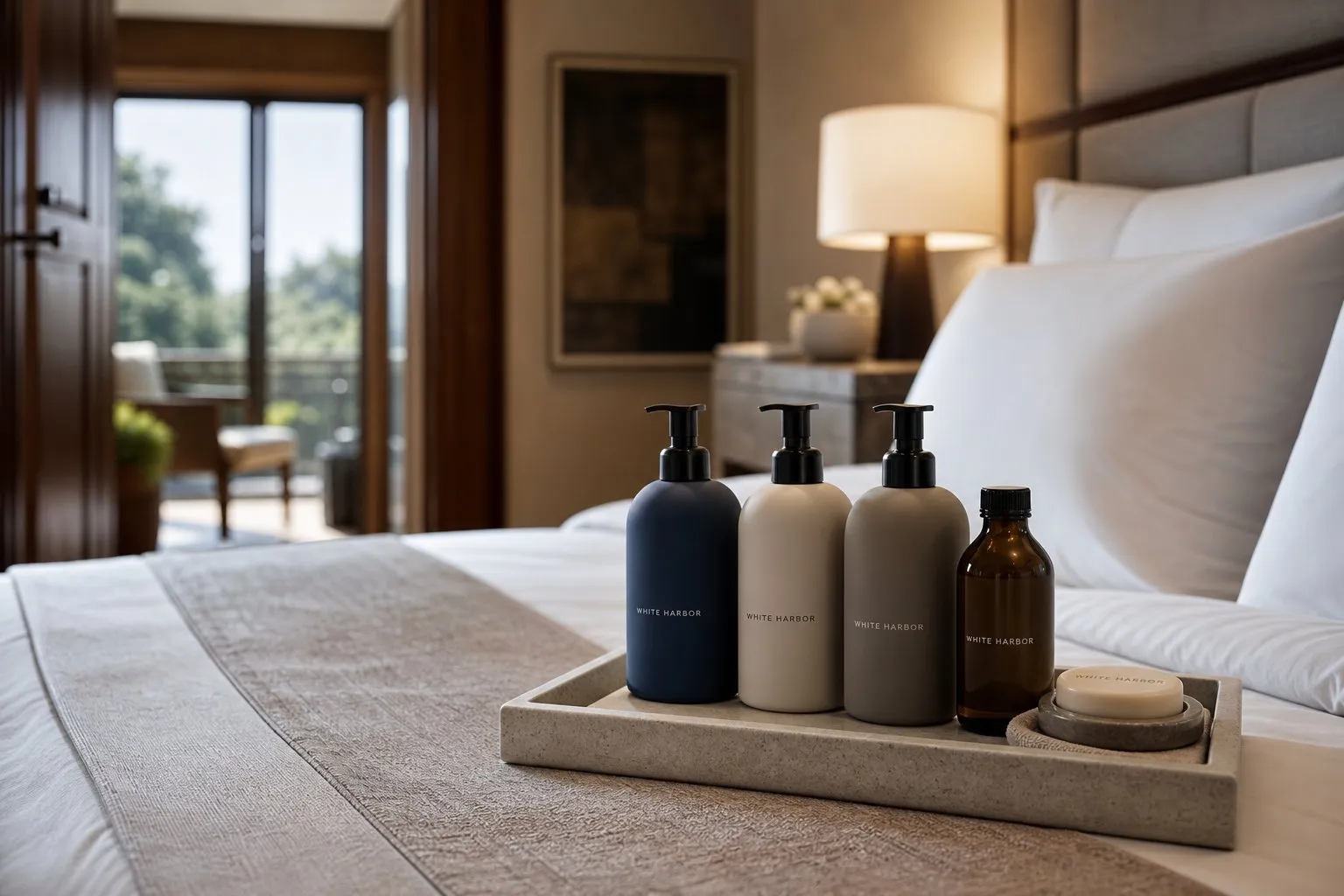
Hotel amenities are the products and services a hotel provides to make a guest’s stay more comfortable. The term covers two things: facilities shared across the property (pool, gym, Wi-Fi, breakfast) and in-room amenities — the toiletries, kits and accessories placed in each guest room, such as shampoo, soap, slippers and a dental kit. As a hotel amenities manufacturer, this guide focuses on the in-room products: what they are, the main types, and how they scale by tier.
We make these for 5,000+ hotels in 40 countries, so here’s the plain, complete answer — useful whether you’re new to hospitality procurement or just want the categories straight.
Hotel amenities: the definition
If you need the formal version — for a brand standard, a tender document, or a hospitality course — here it is.
Hotel amenity (noun) — a product, service or feature provided by a hotel to increase a guest’s comfort, convenience or enjoyment, supplied at no additional charge unless stated otherwise.
The word comes from the Latin amoenitas, meaning pleasantness. That’s a useful root to remember, because it captures what separates an amenity from a fixture: a bed is not an amenity — it’s the thing you paid for. A pillow menu is an amenity. Amenities are what a property adds beyond the basic obligation of a clean, safe room.
Three things follow from that definition, and they’re where most of the confusion lives.
1. “Amenity” means different things in different industries. In real estate, amenities are building features — a gym, a doorman, parking. On booking platforms, the “amenities” filter mixes both senses together: air conditioning, Wi-Fi, and a hairdryer sit in the same list as a swimming pool. In hospitality procurement, which is our world, “amenities” almost always means the consumable guest products — toiletries, kits, slippers. Same word, three scopes.
2. Amenities are usually complimentary, but not always. The default assumption is that an amenity is included in the room rate. Where it isn’t — a paid minibar, a paid spa treatment — properties are expected to label it. Anything placed in the bathroom is essentially always free.
3. An “amenity fee” is not a fee for amenities you can see. Some properties, mainly in the US, charge a daily amenity fee or resort fee covering things like Wi-Fi, pool access, gym use or local calls. It has nothing to do with the shampoo in your bathroom, and it’s a billing practice rather than a product category — worth knowing about because the two terms are easy to conflate.
The terms you’ll see used interchangeably
| Term | What it usually means |
|---|---|
| Hotel amenities | The broadest term — facilities and products |
| Guest amenities | Almost always the in-room products specifically |
| Guest supplies | Trade term for the same products, used by suppliers and distributors |
| Bathroom amenities | Just the bath products and kits |
| Toiletries | The liquids and soap only — shampoo, conditioner, gel, lotion |
| Dry goods | The non-liquid kits — dental, shaving, vanity, comb, sewing |
| Room amenities | In-room products plus in-room features like a kettle or safe |
If you’re writing a specification, use the narrow terms. “Please quote for guest amenities” gets you a wildly variable set of responses; “please quote for bathroom toiletries and dry goods” gets you comparable ones.
Facilities vs in-room amenities
It helps to separate the two senses of the word, because they’re sourced and managed completely differently:
- Hotel facilities are shared services and spaces: pool, gym, spa, restaurant, parking, Wi-Fi, concierge. They’re part of the property.
- In-room (guest) amenities are the consumable and reusable products in each room: the bath line, kits, slippers, fragrance and accessories. These are ordered from a supplier and restocked by housekeeping.
When hospitality buyers say “amenities” in a procurement context, they almost always mean the second group — the products. That’s what the rest of this guide covers.
The main types of in-room hotel amenities
Guest-room amenities fall into a handful of clear categories:
| Type | Examples |
|---|---|
| Bath & body care | Shampoo, conditioner, shower gel, body lotion, hand wash, soap |
| Amenity kits & dry goods | Dental kit, shaving kit, vanity kit, comb, shower cap, sewing kit |
| Slippers | Disposable EVA, waffle, terry, linen or velvet |
| Dispensers & bulk | Wall-mounted refillable dispensers and bulk refills |
| Room fragrance | Reed diffusers, refills, a signature scent |
| Accessories | Wet wipes, pens and notepads, coasters, laundry and shoe bags |
Together these make up a complete guest set. For the full working checklist, see our complete hotel amenities list, and explore each category under bath & body, amenity kits and slippers.
Hotel amenities by tier
The same categories appear at every tier — what changes is the size, quality, packaging and how complete the set is:
- Economy: a clean, functional core — small bath sizes or a 2-in-1, a dental kit, EVA slippers.
- Mid-range (3–4 star): branded 30–40ml bath care, more kits, waffle slippers, perhaps a reed diffuser.
- Luxury (5-star): a premium bath line with a signature scent, full kits, fine slippers, and a complete accessory set in a premium finish.
For the full breakdown, see hotel amenities by star rating and, for the top end specifically, luxury hotel amenities.
Examples of hotel amenities
To make it concrete, a typical mid-range hotel room might include:
- A matched bath line: 30ml shampoo, conditioner, shower gel, body lotion, hand wash and a bar of soap
- A dental kit and a shaving kit
- A pair of waffle slippers
- A reed diffuser
- A shower cap, wet wipes, and a laundry bag
A 5-star room adds a signature scent, fuller vanity and sewing kits, linen or velvet slippers, and a premium finish across the set.
How hotels source amenities
Hotels don’t buy these retail. They’re ordered from a manufacturer or supplier — usually as a branded (private-label) program so the products carry the hotel’s identity. The set is then restocked by housekeeping. Sizes, formats and branding are matched to the property’s tier and brand standard. For how that sourcing works, see how to choose a hotel amenities supplier and our guide to private label hotel amenities.
Why do hotel amenities matter?
Amenities look like a small line item, but they do outsized work for a property:
- Guest experience. They’re among the few things a guest physically touches and smells. A good set makes a room feel cared-for; a cheap one undercuts everything else.
- Reviews and ratings. Cleanliness and value — two of the categories most tied to amenities — directly affect a property’s score and, through it, its bookings and rate.
- Brand expression. A branded, consistent set turns a generic room into “this hotel,” especially when it carries a signature scent.
- Sustainability and compliance. With single-use plastic increasingly regulated, the amenity program is now part of a property’s ESG story and, in some markets, its legal compliance — see sustainable hotel amenities.
In other words, amenities are a low-cost lever on guest satisfaction, brand and compliance all at once — which is why hotels treat them as a deliberate decision rather than an afterthought.
How the amenity became standard
Worth knowing, because it explains why the category looks the way it does today.
For most of hotel history the in-room offering was a bar of soap and not much else. What changed it was branding. Once properties realised that a guest carries the bottle home, looks at the label, and associates the scent with the stay, the amenity stopped being a hygiene item and became a marketing surface. Through the late twentieth century the upper tiers competed on it — designer names on the bottle, larger sizes, more pieces in the set.
The second shift is the one we’re in now, and it runs in the opposite direction: from more to better. Single-use plastic regulation has made “six small bottles per room per night” untenable in a growing list of markets. California prohibits small plastic amenity bottles in lodging, and other jurisdictions are moving the same way. The response has been fewer, larger, refillable formats — wall dispensers, bulk liquids, and paper-based packaging for dry goods.
So the modern brief is harder than the old one. You’re being asked to produce something that feels generous, carries your brand, and generates less waste, all at once. That’s why formats and materials now get as much attention in a tender as the formula does — and why the eco line and dispensers have gone from niche to default in barely a decade.
How hotels choose the right amenities
The right set depends on three things: the property’s tier (economy to luxury), its property type (city hotel, resort, serviced apartment, short-stay), and its brand standard. A budget motel and a five-star resort draw from the same categories but make very different choices on size, quality and branding. For how this varies, see amenities by property type, and for the tier-by-tier view, amenities by star rating.
Frequently asked questions
What are hotel amenities?
Hotel amenities are the products and services a hotel provides for guest comfort. They include shared facilities (pool, gym, Wi-Fi) and in-room guest amenities — the toiletries, kits, slippers, fragrance and accessories placed in each room.
What are examples of hotel amenities?
In-room examples include shampoo, conditioner, shower gel, soap, body lotion, a dental kit, a shaving kit, slippers, a reed diffuser, a shower cap and wet wipes. Facility examples include a pool, gym, spa and Wi-Fi.
What’s the difference between hotel amenities and facilities?
Facilities are shared spaces and services across the property (pool, gym, restaurant). In-room amenities are the consumable and reusable products in each guest room, ordered from a supplier and restocked by housekeeping.
What amenities does a 5-star hotel provide?
A premium bath line with a signature scent, full vanity and sewing kits, linen or velvet slippers, a signature room fragrance, and a complete accessory set in a premium finish — see luxury hotel amenities. A robe belongs in a five-star room as well, but it is linen rather than an amenity and comes from a different supplier.
What is the meaning of amenities in a hotel?
An amenity is anything a hotel provides beyond the basic room to make a stay more comfortable — from a pool or gym at property level to the shampoo, soap, slippers and kits placed in the room. The word comes from the Latin amoenitas, “pleasantness”. In hospitality procurement it almost always refers to the in-room products specifically.
Are hotel amenities free?
In-room amenities — toiletries, soap, kits, slippers — are complimentary and included in the room rate. Anything chargeable, such as minibar items or spa treatments, has to be labelled as such. A separate “amenity fee” or “resort fee” on your bill covers property facilities like Wi-Fi and pool access, not the products in your bathroom.
What is the difference between guest amenities and guest supplies?
They describe the same products from different sides of the transaction. Hotels say guest amenities; suppliers and distributors say guest supplies. Both mean the consumable in-room range — bath products, kits, slippers and accessories.
What are room amenities?
“Room amenities” usually covers both the consumable products in a guest room and its in-room features — so it can include the kettle, safe, iron, air conditioning and hairdryer alongside the toiletries and slippers. Booking platforms use the term in this wider sense, which is why it appears in filters next to Wi-Fi and parking.
Are hotel amenities the same as toiletries?
No — toiletries are a subset. Toiletries means the liquids and soap: shampoo, conditioner, shower gel, lotion and hand wash. Amenities covers those plus dry-goods kits, slippers, room fragrance and accessories, and at property level the facilities too.
Sourcing amenities for your property? Request a quote with your room count and tier, and we’ll match a complete guest set — bath care, kits, slippers, fragrance and accessories — to your brand.